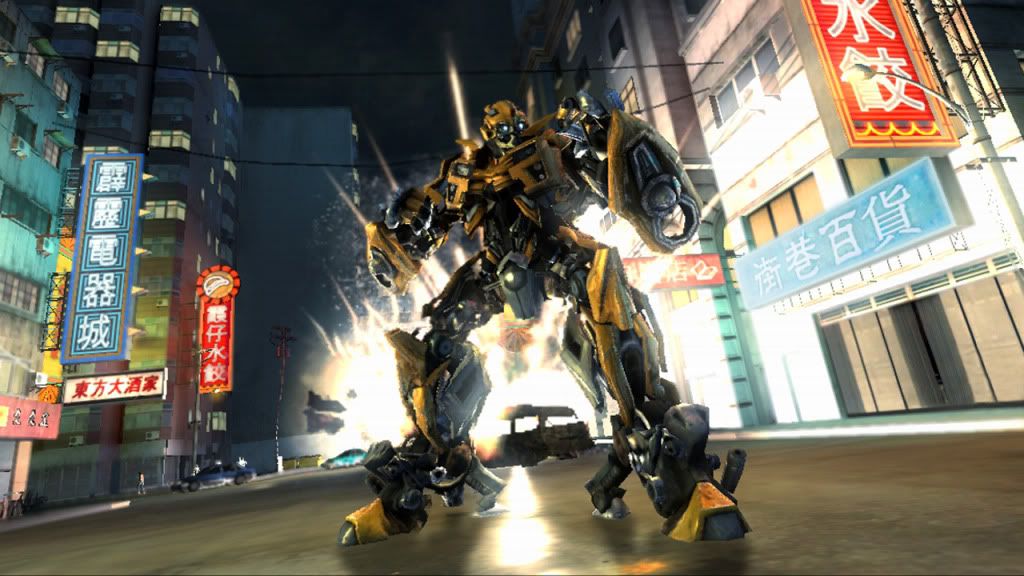


Transformers: Revenge of the Fallen Review

Imagine what it would be like to become a Transformer. Walking, jumping, and climbing in your humanoid form would be pretty familiar, and you could easily get the hang of whipping out your guns to blast enemies. Driving yourself around might be a bit awkward at first, and flying would be significantly trickier, but the real problems would come when you tried to transform. Shifting your physical form would be really disorienting, and it would take a while before you really mastered it.
Hitman

Hitman

Duisorem ipsum dolor sit amet, consectetuer adipiscing elit. Quisque sed felis. Aliquam sit amet felis. Mauris semper, velit semper laoreet dictum, quam diam dictum urna, nec placerat elit nisl in quam. Etiam augue pede, molestie eget, rhoncus at, convallis ut, ...
Hitman
Showing posts with label Playstation 3. Show all posts

Transformers: Revenge of the Fallen Review

Transformers: Revenge of the Fallen Boxshot
Despite a slow start and some lingering issues, Revenge of the Fallen really makes it fun to be a Transformer.

The Good

  • Each Transformer has powerful weapons and abilities
  • Two sizable campaigns
  • Unlockables and bonus objectives enhance each mission
  • Strategically engaging online multiplayer.

The Bad

  • Controls are tough to get the hang of
  • Environmental hang-ups are prevalent
  • Some movement issues linger throughout
  • Uneven voice acting.

Imagine what it would be like to become a Transformer. Walking, jumping, and climbing in your humanoid form would be pretty familiar, and you could easily get the hang of whipping out your guns to blast enemies. Driving yourself around might be a bit awkward at first, and flying would be significantly trickier, but the real problems would come when you tried to transform. Shifting your physical form would be really disorienting, and it would take a while before you really mastered it. That's actually a pretty accurate breakdown of what it's like to play Transformers: Revenge of the Fallen. In the early going, the controls are uncomfortable but functional. As you play through either of the solid campaigns, you'll get better and better until you reach a point where you can fluidly move between different forms and dispatch your enemies with style. Then the game becomes a fun, engaging romp through the Transformerverse, and taking your skills online gives you a new tactical challenge. Though it takes awhile to get there, and it never outgrows some of its problems, Revenge of the Fallen is an entertaining way to step into the chassis of a giant transforming robot from space.


The two campaigns--Autobot and Decepticon--loosely follow the plot of the movie. Each one takes a solid amount of time to complete, and they are different enough that it is worth playing through both. The Transformer models are shiny and detailed, capturing the look of the movie nicely. The voice acting is less impressive. While some Transformers, such as Megatron and Optimus Prime, sound great, others are almost unintelligible, thanks to poor volume matching or overzealous robotic effects. And the human characters (specifically Shia LeBeouf and Megan Fox) are so badly voiced that you'll be thankful only some of the missions actually parallel the movie. Other missions diversify the action with familiar mission archetypes: escort/kidnap, defend/destroy, checkpoint race, miniboss fight, and the like. Each mission plays out in an open area full of items you can destroy (cars, tankers, and light structures); though your wrecking power is so substantial you'll probably wish for a bit more environmental destructibility.


Between the mission types and the maps, there isn't a whole lot of variety. It's not quite tedious, but things can start to feel a bit too familiar as you progress. Fortunately, a healthy array of bonus challenges and unlockables do a good job of keeping things interesting. Accomplishing the two bonus objectives in each mission nets you a solid haul of attribute-boosting energon, and shooting the five targets in each area will earn you even more energon, as well as stall the clock so you can strive for a higher medal by finishing quickly. Overarching objectives challenge you to accomplish certain tasks with certain characters, and doing so unlocks episodes of the original Transformers cartoon, as well as vintage paint jobs and concept art. These goals help flesh out the experience and keep you engaged because they give you something else to do during missions besides focus on the primary objectives. Accomplishing all the bonus objectives and earning a gold or a platinum medal is a tough challenge, and you won't even come close until you've mastered the controls.


There are three different forms ("modes") that each Transformer can take: robot, weapon, and vehicle. In robot mode, you walk around in humanoid form and can jump, climb buildings, and melee attack. Holding L2 changes you into weapon mode, allowing you to strafe and blast opponents with your primary and secondary weapons. These two modes are easy to master and switch between, but vehicle mode is a bit trickier. Holding R2 will transform you into a vehicle, and you'll immediately start driving or flying, depending on your character. It's cool to watch, but figuring out how your momentum will (or won't) be preserved through the transformation is a bit tricky. Until you get the hang of it, you'll often find yourself on an unexpected vector, speeding off in the opposite direction or just plowing into a building.

Homing missiles make Grindor's helicopter form particularly potent.


Freeing yourself from environmental hang-ups is a hassle, especially when you're trying to escape the battle fray in order to lay low and regenerate health. Driving around the maps, you may find yourself getting stuck on low barriers or other objects that you were previously able to drive over or through. Flying can be even more finicky, especially if you get into a tight spot where you can't transform. Jet and helicopter controls may also present a problem for some because there aren't many customization options when it comes to the steering and altitude-adjustment controls. Expect to suffer some frustration and awkwardness throughout a good chunk of your first campaign. You'll be able to accomplish your objectives; you just won't look pretty doing it.


But once you've mastered the controls, you can really start to flex your metal muscles. You'll be better at avoiding awkward transformations and getting back on track should you get hung up. You'll get the hang of flying and driving skillfully, and you'll be tearing around each area with confidence. Some of the coolest things you can do in the game are so-called "advanced" maneuvers that you execute in vehicle form. The advanced jump launches your Transformer out of car form and into a high jump (fliers are stuck with the strategically powerful yet unexciting hover ability). These jumps are great for leaping over low buildings and obstacles, but when you string a few together, you can drive/hop from rooftop to rooftop, traversing crowded areas in a speedy and exhilarating fashion. And let's say your enemies have appeared down the street and are heading your way. You transform into a vehicle and race to engage them, firing your vehicle weapon to soften them up. When you get close, you fluidly shift out of vehicle mode, throw your momentum into a deadly melee attack and watch a slow-motion close-up of your Transformer obliterating your enemy. It's pretty awesome.


Not only is the advanced melee attack really satisfying, but it and other stylish kills (like offing an enemy while jumping, scoring a headshot, and the like) will also fill up your overdrive meter. Overdrive makes you tougher, increases your weapon damage, and keeps you from overheating, allowing you to tear through groups of foot soldiers with ease or whittle down a boss' health quickly. Earning and using overdrive is a great way to exercise your formidable moveset, and it's essential to getting through levels quickly and earning a top medal. While it is very satisfying to earn a platinum medal, the real enjoyment comes from wielding your diverse abilities in a skillful way. You feel powerful and excited to be a Transformer, and that is Revenge of the Fallen's greatest success.

Punching an enemy so hard that they explode is just plain great.


Online multiplayer offers a distinct new challenge that is best tackled once you've mastered the controls. The modes and maps are pretty standard fare, and they serve as a competent stage for battle. Each Transformer has a unique loadout that includes a primary weapon, secondary weapon, and special attack. In the single-player campaigns, these different abilities provide some welcome variety. In multiplayer, they add a whole new level of strategic depth. Having Long Haul's combat healing ability can help a Decepticon team stay alive long enough to capture a control point, while a well-timed electromagnetic pulse attack from Bumblebee can give the Autobots a deadly window of opportunity. Teams have to strategize in order to make the best use of the complementary special attacks, though team-only chat doesn't kick in until the match begins, so be careful about how much you say in the game lobby. Coordinating your team roster and experimenting with different lineups yield a surprising amount of possibilities. The interplay of abilities and weapons also makes the otherwise run-of-the-mill game types much more complex and engaging.


Though it isn't immediately accessible, Revenge of the Fallen has a good amount of fun and satisfying gameplay. The initial awkwardness of the controls is a bit vexing, and some issues linger no matter how good you get. The single-player missions and multiplayer game modes aren't very diverse, but the various bonus challenges and strategic nuances add some welcome depth. What Revenge of the Fallen does best is make it fun to be a Transformer by giving you a powerful set of abilities and open maps where you can put them to use. It's enjoyable and engaging, and it's probably the best Transformers product you'll see this summer.

X-Men Origins: Wolverine

It's derivative and occasionally buggy, but solid action and over-the-top gore make X-Men Origins: Wolverine a cut above other movie tie-ins.

The Good

  • Raw, brutal action
  • Varied enemy types
  • Good showcase of Wolverine's powers.

    The Bad

    • Disappointing (and sometimes buggy) boss fights
    • Cheap deaths
    • Too easy.

    X-Men Origins: Wolverine Boxshot
X-Men Origins: Wolverine will give you new insight into how much damage indestructible, razor-sharp claws can do to a human body. This is a game that revels in gore, with decapitations, eviscerations, and mutilations drenching the screen in blood. It may be derivative, a cakewalk, and at times buggy, but the sheer visceral impact of the over-the-top violence in X-Men Origins is enough to make it a fun action game, as well as one of the better movie tie-ins released recently.


It helps that the violence in X-Men Origins: Wolverine is backed up by decent gameplay, and though it doesn't bring anything new to the third-person action genre, it's still solid and satisfying at most times. You play as the titular Marvel mutant, with the game's muddled storyline mimicking and expanding on events in the movie of the same name. Along the way, you take Wolverine through the jungles of Africa, the hidden Weapon X base at Alkali Lake, the interior (and exterior) of a massive casino, and more. You have to take on groups of increasingly aggressive and dangerous enemies, solve not-too-taxing environmental puzzles, as well as go up against several guest boss villains from the Marvel universe. Unfortunately, the game doesn't do a great job of introducing these nefarious individuals--such as the Blob and Gambit--and often throws them in with little explanation of why Wolverine needs to beat on them in the first place.

Your weapons of choice for dispatching these villains are Wolverine's claws, and even though the game's jumping timeline means that you'll be playing as both pre- and post-adamantium Logan, the claws retain their indestructible ability to slice through practically anything throughout the game. You have light and heavy attacks that you can string together to perform various combos, and also an extremely useful lunge that lets you launch Wolverine at enemies from a distance. These button-based combos are easy to pull off, and get gradually more intricate as you unlock more. As Wolverine gains levels, new combos open up, as well as four different fury attacks, which are supermoves that require you to build up your rage meter before unleashing. These four attacks can be upgraded as Wolverine gains experience, giving the game a very basic character-customization element.

Although spamming the same combos can prove useful early in the game, you won't be able to get away with mindless mashing for too long. The game does a good job of forcing you to change your tactics, sending at you a wide variety of enemy types that require different attacks and combos to dispatch. For example, though the lunge may work on low-level enemies, tougher foes and midlevel bosses will simply swat you out of the air. With a bit of practice, all of Wolverine's moves can be chained seamlessly, making you feel extremely powerful as the mutant unleashes his rage on groups of enemies.

You want gore? Then you've come to the right place, bub.

Among the game's highlights are a number of particularly gruesome ways that you can dispatch your foes. Some are situational; throw enemies near any conveniently located floor or wall spike and you'll automatically impale them. Some are part of normal attacks, which can result in arms, legs, and heads flying in any direction. The best ones are Wolverine's various flashy finishing moves. The angry mutant can stab an opponent in the side of the head with one set of claws before decapitating them with the other; rip off someone's arm and beat him to death with it; literally tear someone in half; use the spinning blades of a helicopter to transform an enemy's head into bloody chunks; and much more. It's certainly the most blood-soaked superhero game in years, and one that younger Wolverine fans should avoid. However, adult fans of the character will probably find this a guilty pleasure, in turns laughing and wincing at the blood-soaked display in front of them.

Your enemies will try to give as good as they get, and Wolverine will have to face off against a good variety of human, mutant, and robotic foes. Most pack heavy firepower or super abilities, but Wolverine has his rapid healing to fall back on. His health bar will automatically refill after a few seconds of not taking damage. In fact, Wolverine's health recovers quite quickly, which makes the game fairly easy to breeze through on normal difficulty. It's rare to feel too threatened by the odds stacked up against you, and chances are that the only time you'll die in the game is when you fall off of a high ledge or into water. That's right: Wolverine can survive bullets, swords, flames, explosions, and lasers, but fall into one of the game's few predetermined no-go zones and it's instant death.

This is particularly jarring during the game's final boss fight, in which falling off means having to restart the battle from the last checkpoint. Wolverine's other boss fights are mostly anticlimactic, with some of the bosses even freezing up on occasion. In one instance, a boss character simply stopped moving, whereas in another it failed to reappear after being thrown offscreen. These occurrences were rare but quite annoying when they happened, and to its credit, the game does have two standout showdowns, the first with the Blob, and the second a fight with a gigantic Sentinel. But though the latter is a fun multistage battle that culminates in a spectacular finishing blow from the near-invincible mutant, it's probably not quite the epic face-off that fans of the X-Men series have been hoping for.

The Sentinel showdown in one of the game's better boss fights.

X-Men Origins: Wolverine is easy; you'll likely finish its five chapters in fewer than 10 hours. There's no multiplayer here, and most of the replay value is in finding hidden alternate costumes throughout the levels, as well as an unlockable hard difficulty. There are only a few extra costumes (such as Wolverine's classic brown spandex), but once unlocked, they can be used while you play through levels to replace the boring "faded jeans and white shirt" look that serves as Wolverine's default.

The game's environments--particularly its indoor ones--are plain-looking; the various corridors and laboratories lacking real distinctiveness. Characters fare a little better, sporting good animations if lacking a little in the detail and sharpness departments. The model of Wolverine himself is the standout and features an interesting structure that shows off real-time damage. Get hit, and the damaged areas will show the exposed muscle underneath. Keep on getting pummeled and you'll even see the character's skeletal structure exposed, to be gradually replaced by muscle and skin as Wolverine heals. This sounds better than it looks--most of the time, this real-time damage lacks clear definition, looking more like random red splotches on Wolverine's clothes than serious injuries. As for sound, the highlight again is Wolverine, with movie star Hugh Jackman lending his voice to the character. However, other environmental effects are inconsistent. Most of the time, the various slashing, gunshots, and explosions in the game sound appropriately meaty, but there are some occasions when onscreen actions seem to lack the accompanying sound altogether.

Although X-Men Origins: Wolverine does sport some clear technical deficiencies, it's never enough to fully distract you from what it is at its core: a solid if unspectacular game that, for once, takes those metal claws of Wolverine seriously. This is a game that's at its best when it's brutal, and though it lacks any real depth, it's fun while it lasts.


Guitar Hero: Metallica First Look

We take a look at the first Guitar Hero spin-off to support guitars, drums, and vocals.

If you want a good example of the incredible growth the Guitar Hero series has undergone since its 2005 debut, last year's Guitar Hero: Aerosmith is a great place to start. It's hard to tell who exactly the headliner was in that show: the phenomenally successful band that's been around for nearly 40 years or the phenomenally successful video game franchise that's existed for a 10th of that time. No matter the answer, the formula must have worked, because Activision will soon be releasing a similar spin-off in the form of Guitar Hero: Metallica. Besides the obvious switch from bluesy hard rock to heavy metal, Guitar Hero: Metallica will differ from its predecessor by supporting the full suite of instruments bundled with Guitar Hero: World Tour while also cranking up the level of fan service packed into the game. Just yesterday, some members of the Neversoft development team dropped by the GameSpot office to give us a look at what to expect out of the final release.

Metallica band members are rendered in Guitar Hero's signature caricatures.

The challenge that exists in creating a music game dedicated to such a massive artist is the sense of progression in the game's Career mode. After all, when you're already on top of the world, there's not a lot of vertical growth left to achieve. Neversoft's solution to this will be to replace the documentary-style approach of the Aerosmith game--which took you on a chronological journey of the band's greatest hits--with a fleshed-out storyline that puts you in the shoes of a garage band looking to achieve their dream of opening for Metallica. Animated interludes that play out between sets show a young collection of Metallica fans doing their best to win over the famous rockers, and the visual style is definitely in the rough and grungy aesthetic Guitar Hero fans are familiar with.

The progression of the game's Career mode will alternate between performances by Metallica--complete with eerily accurate character models for all four members--and performances by the upstart band featuring characters of your own creation. Metallica will be playing some of their hits, such as "Enter Sandman," "Master of Puppets," "No Leaf Clover," "The Unforgiven," and "Nothing Else Matters," alongside some lesser-known numbers, while your group will be covering the work of bands that are associated with Metallica in some way. Whether it's a group that played with Metallica, inspired them, or used them as a source of their own inspiration, there will be a wide variety of other bands' music available to you. A few examples are Bob Seger's "Turn the Page," Social Distortion's "Mommy's Little Monster," Mastadon's "Blood and Thunder," Lynyrd Skynyrd's "Tuesdays Gone," and Judas Priest's "Hell Bent for Leather"--plus an unnamed Queen song. Similarly, the venues you'll be playing in will be those taken from key moments in Metallica's career and will include the likes of the Los Angeles Forum, Hammersmith Apollo, and Tushino Airfield in Moscow.

Like the Aerosmith game before it, Guitar Hero: Metallica will have a lot of fan service for those who consider themselves big followers of the band--the only difference is that Metallica will have a lot more of it. As you progress through the game's songs, you'll unlock all sorts of bonus features, such as video of old live performances and behind-the-scenes footage at Neversoft, pictures such as backstage photos and setlists, and other audiovisual fragments of the band's history. One of the more interesting unlockables is something called "Metallifacts," which is a performance of each song in the game by the computer accompanied by pop-ups on the screen containing facts about each song. For example, if you didn't realize before that "For Whom the Bell Tolls" was inspired by James Hetfield's love for the work of Ernest Hemingway and represents one of the many examples of literary allusion in his songs, well, now you do. Further unlockables include details for each song, such as lyricist, producer, original recording date, and complete lyrics.

Expert+ drum difficulty allows you to play with two kick pedals.

One thing that sets Metallica apart from a lot of bands featured in Guitar Hero games is the prominent use of double bass pedal in their drum work. For World Tour, Neversoft had to effectively cut the number of pedal strikes in half for a lot of songs on the expert difficulty level, at the risk of forcing players to upgrade their human feet into something a little more cyborg. Now they've introduced a new difficulty setting for drums called Expert+, which allows you to plug in a second kick pedal (using a splitter accessory) and play the songs with full pedals. We watched as a member of Neversoft played through one Metallica song on this setting, and at several points during the song his entire note highway was filled purple kick pedal notes. It made our feet hurt just looking at it. But you can take solace in the fact that this is a purely optional bonus setting for mildly insane drummers; normal players won't be required to drum with both pedals on the standard, beginner-to-expert difficulty levels.

This being Neversoft's second stab at the multi-instrument branch of rhythm games, it has had some time to see what works and doesn't work as far as the gameplay is concerned. What Neversoft has found is that it liked the way players mimicked songs, but there was some room for improvement in terms of how players could tell whether or not they were doing a good job of it. So Neversoft made a few small but noticeable changes to the game's heads-up display. Now your overall success gauge won't be tucked away in the upper left corner; it will be attached to each player's own note highway, so as to limit the distance your eyes need to travel between seeing which notes you're playing and seeing how well you're playing them. Another change has been made to the overall feedback system for how well you're doing as a band. If the entire group is at risk of failing a song, the edges of the screen will glow progressively redder, as you might see in a first-person shooter along the lines of Call of Duty.

One of the biggest features from Guitar Hero: World Tour, the music studio, will be available in the Metallica game. A few Metallica-specific guitar sounds have even been added, such as the ESP Truckster guitar tone. All the songs you make in the music studio here will be compatible with those made in World Tour's music studio, and vice versa. That's good news if you've created a discography's worth of Metallica-inspired tunes in the World Tour music studio and would love nothing more than to play them in Metallica's favorite venues using spot-on doppelgangers of the band. You'll have the chance to do that when the game is released this spring.


Guitar Hero: Metallica

Activision
Neversoft Ent.
Rhythm / Music
Release:
Mar 29, 2009 »
ESRB:
Teen

Wanted: Weapons of Fate Updated Hands-On

We blast our way through three demo levels of this movie-based third-person action game.

There's a downside to being a stone-cold killer. Oh sure, being a globe-trotting member of a secret fraternity of superpowered assassins has its perks: cutting-edge weapons, an expense account that would rival the GDP of a small nation, not to mention that whole license-to-kill thing. Nevertheless, for every aspect of an assassin's life that just plain kicks butt, there's the flipside: the fact that practically wherever you go, people want you dead. That's certainly the case in Wanted: Weapons of Fate, the upcoming action game from developers Grin and based on last year's blockbuster movie. This week we had a chance to take the game for yet another spin, including a look at the tutorials and three levels from the game.

In Wanted, you'll play as both Wesley Gibson (played in the film by James McAvoy) and his father, Cross (played by Thomas Kretschmann). Both are members of the Fraternity, a supersecret band of assassins whose killing abilities are far beyond normal. Wanted's tutorials will take you through the basics, from basic aiming and shooting (controlled, respectively, with the left and right triggers), to the more-complicated gunplay of curving bullets and using the game's cover system and adrenaline feature.

Curving bullets around cover is a great ability...

Much like in the film, getting Wesley to curve bullets takes some adjustment. The mechanic is controlled with the right bumper (R1 on the PlayStation 3), which will bring up an arch tied to your target of choice that shows the curving path of your bullet. With some careful manipulation of the right stick, you can adjust the arch of the bullet, including not just the direction of the curve but also the height of the arch's apex (which is sometimes useful when trying to curve a bullet in tight quarters). Color-coding helps here: Once your target changes in color from red to white, you can let go of the shoulder button and the bullet will fly to its target.

Interestingly, curved bullets are not always a guaranteed kill. Occasionally the game will give you a nice "bullet cam" view of the shot curving toward your foe's head. More often, especially in the later levels of the demo that we played, a curving bullet will merely wound your opponents, often causing them to drop out of cover, which will give you a chance to unload on them as a result.

The game's adrenaline system will reward skillful shooting by giving you with one adrenaline point for every successful kill. Adrenaline is what powers abilities such as curving bullets and "assassin time," which briefly slows down the game, giving you a chance to quickly pick off multiple targets. The demo levels that we played maxed our adrenaline points at either one or two, depending on the level, but if you were careful with your bullets, you could effectively keep your adrenaline high and your assassin abilities always at the ready.

Though we've seen all three of the demo levels in our previous looks at Wanted, we saw a few aspects of each that we hadn't noticed before. The first nontutorial mission is called "When the Water Broke," and features Cross making his way through a quaint village and looking to make contact with a female character known as Alyse. After dealing with a bunch of peons with your curving-bullet ability--or the gruesome close-quarters kill with a press of the B button--you'll get to a sequence in which you must protect Alyse. She's located in an apartment building across from you, she's holding a baby (presumably, the infant Wesley), and her building is being overrun by bad guys. As Cross, you must protect her as she makes her way to safety by taking down those thugs using every trick in your book. You use curved bullets, straight-ahead gunplay, and even sequences in which you're blasting baddies to bits with a turret or sniper rifle. Strangely enough, the enemies all seem to be focused on you and don't seem to even notice Alyse and the baby; then again, you are the one with the gun.

The second level features Wesley in Chicago, looking to deal with that city's chapter of the Fraternity. It should be noted that the demo doesn't reveal much in terms of the game's narrative, so we can't tell you exactly why Wesley is looking to take down the Fraternity with extreme prejudice. He just is.

Anyway, the level starts off in a courtyard, with Wesley sneaking around and eventually taking one of the guards unaware. You can choose to execute him on the spot with a press of the B button, or use him as a meat shield for as long as his corpse will hold up, which, considering the sheer number of enemies you face in the courtyard, isn't long at all. This level serves as a good reminder of the game's cover system, which uses the A button and the left stick to move from one cover point to the next. It also serves as a reminder that curving bullets is not the answer to all of an assassin's problems, as proved when you face an enemy wielding a riot shield, for which curving bullets are essentially no match.

In our experience in the demo level, there were two ways to deal with the riot-shield problem: A) run directly at the guy and hope to take him down with a melee attack, or B) use blind fire and cover in a smart way. Although Option A is the easier solution, it doesn't work that well at the higher difficulty level because you are much more vulnerable to damage. As a result, B is often the better but more difficult option. By firing blindly when in cover and then quickly moving to another position, you can fool the enemy into thinking you're in one spot when you're really in another. It's an effective method of sneaking up on a bad guy unawares, but realize that the window of opportunity is a small one.

After the courtyard, you're taken to a quick-time event as Wesley breaks into a warehouse and causes all sorts of mayhem. The quick-time events play a bit like the aforementioned "assassin time": short, scripted sequences interrupted by interactive bits in which you fire at enemies or even at the bullets they're shooting at you. Miss them and you'll end up wounded or worse and have to start the whole sequence over again.

This job requires bullets. Lots and lots of bullets.

The final demo level was undoubtedly our favorite if only for its setting: a cramped airliner brimming with dead passengers and heavily armed bad guys. The confined movement area gave the mission an intense feel; we used passenger seats to avoid fire, pushed beverage carts up the aisle as moving cover, shot at fire extinguishers to blow them up (taking the airplane door and any bad guys nearby with it), and more. Despite its high points, the level had its quirks. The inability to move across passenger rows to get from one aisle to the next felt artificial, and the enemies seemed more bullet-resistant than in previous levels. It was also strange to have no living passengers on board; having to fight among civilians, choosing which targets to shoot and which to avoid, would have amped up the level even higher.

Based on our time with the demo, Wanted's greatest strengths can be found when you are truly in the flow of blasting arcing bullets at bad guys, sneaking from cover to cover, and diving full-throttle into the action. We're hoping that the game's story ties all of this action together in a meaningful way and that the action stays consistently engaging through the entirety of the game. We'll have our answers when Wanted arrives on March 24, so stay tuned for more in the coming weeks.

Wanted: Weapons of Fate
Warner Bros. Interactive Entertainment
GRIN
Modern Shooter
Release:
Mar 24, 2009 »
ESRB:
Mature

The Chronicles of Riddick: Assault on Dark Athena Hands-On

A new chapter in the Riddick chronicles opens in March, and we had a hands-on with the first three hours of the new story.

Earlier this week, we braved the cold London weather to visit Atari's worldwide headquarters to play the first three hours of The Chronicles of Riddick: Assault on Dark Athena. On arrival, we'd not even removed our jacket, gloves, or scarf before our representative was attempting to set the record straight on what the game actually is. "There's been a lot of confusion surrounding Dark Athena," he said. "I've had people asking if it's a remake of the original, a multiplayer expansion, a new game. In truth, it's all these things." This is most definitely a full game, with a brand-new story and multiplayer mode, as well a remade version of 2004's Escape from Butcher Bay as a bonus. With the record set straight, we were let loose on the story part of the game, playing nonstop for three adrenaline-packed hours.

Atari promises that Dark Athena's story will take about 11 hours, compared to Butcher Bay's nine.

Dark Athena continues the story from Escape from Butcher Bay, with Riddick and the bounty hunter Johns in cryostasis, drifting through space. Their ship is eventually picked up by a pirate vessel--the titular Dark Athena--and though Riddick manages to wake up in time, Johns' pod is infiltrated and he is taken prisoner. Hiding in the shadows, Riddick steals the captain's hairpin and is soon scouting the ship with nothing but the darkness and the hairpin as his weapons. However, before getting into the story, you have to play through a tutorial that is presented as one of Riddick's deep-sleep dreams. The basic movements remain the same as in Riddick's Xbox debut, but he has picked up a couple of new moves during his time in stasis. Many weapons are ID-tagged to their owner, but Riddick can now pick up dead bodies and manipulate them to fire. This is useful in a firefight, but at the start of the game, it's actually more useful for puzzle-solving--dragging a body around to shoot out glass windows, for example. Playing on the Xbox 360, we were also able to use the left bumper to pop our gun around corners, which lets you take cover while still going on the offensive. Atari promises that Dark Athena will be much more focused on gunplay than Butcher Bay was, and it was only a short time before we had regular access to guns. We ended up using the tranquiliser gun most frequently, temporarily stunning opponents before slicing them up in incredibly stylish fashion using the ulak blades. There will even be mechs that you can jump in, although we didn't make it far enough to see them.

It doesn't take a lot of play time to realise that the pirate ship is taking humans and converting them into drones, which are slaves that will automatically patrol a given area, or that can be controlled from afar by another person. Their faceplates change between red and white to indicate their current state, the former meaning that they'll follow set movement patterns, the latter meaning that they're more alert and looking for something specific. The game still favours the stealthy approach, at least during the time we played, and to enhance this you can still enter a crouched mode to hide and activate Riddick's night vision to help you in the shadows. What's most surprising is that the game still uses the NanoMED system to replenish health, so you need to collect med canisters and use them at certain points to regenerate. It feels more retro than the regenerative health system favoured by most shooters these days, and it results in quite a tough game even on the normal difficulty setting.

We managed to meet some of the major characters and get a feel for the overall story. The first person we spoke to was a young girl hiding out in the ventilation system; her mother was taken prisoner, and her father was "turned into a monster." Then there is the captain--played by actress Michelle Forbes--who clearly has a history with Riddick, and you can overhear soldiers talking about wanting to become her sex slave. Indeed, the world of Dark Athena is a very seedy place, from the conversations held by its crew, to the military pornography such as the Warchix magazine, and characters who masturbate as you walk past. The game's story is told completely using the in-game engine, with excellent lighting and character modelling, particularly for Vin Diesel's Riddick. Atari also teased us with news that 80 percent of the game will take place on Dark Athena, but a final act will offer something "completely different."

Dark Athena certainly looks more action-based than its predecessor, with a greater variety of weapons.

Although Dark Athena is often shockingly violent and even depraved, it manages to remain mature thanks to some excellent dialogue and voice acting. About an hour and a half in, we came across prison cells housing about eight different prisoners. Some of them were vital to our progress, whereas others were merely there to fill in the backstory. One female character had clearly been wronged by Riddick and told us that, among a shower of expletives, she was going to kill him. One particularly nasty character called Jaylor explained how he wanted to rape one of the other female inmates, after which he referred to you as a c***. Thankfully, this was offset by more sympathetic characters such as Senate, who had previously captained the ship, and Dacher, whose story about losing his wife was quite touching.

Some of these characters also turned out to be necessary in progressing through the game. Jaylor requested that we kill one of the pirates onboard and return his gold tooth, and in return he gave us the access code for a locker. Silverman was an engineer who made us a tool to enter certain other areas, and she also turned out to be the mother of the girl that we saw in the vents. And Dacher, the widower mentioned before, helped us hack into the ship's communication system and make it down to the drone control area. Our play time drew to a close with two fantastic set pieces. The first was one we'd seen in a previous demo, in which we jumped into one of the remote drone terminals and caused havoc from afar. You have access to only a limited number of drones, but running around and shooting up everything was great fun. The second was at the heart of the ship and its gravity generator, wherein shooting people sent them flying into the huge gravity pillar at the centre.

Before we left Atari, we also managed to take a quick look at the remake of Escape from Butcher Bay. Fans of the original game should remember that it was released in 2004, fairly late in the Xbox life cycle, which means that it was one of the most visually attractive games ever released on the system. The remake improves these visuals even further, with new textures for the environments and characters. The new weapons and moves have also been included from Dark Athena, and consequently you'll be able to pop your gun out from behind objects for the first time in the game.

Our three hours with Dark Athena were incredibly enjoyable, and we really wanted to stay longer and play more. The game offers all of the elements that made the first game so great, and the voice acting, set pieces, and new combat elements added even more to the experience. Atari claims that the game is finished, and that the team is now bug testing and polishing ahead of the March release date. We've also been promised a chance to play the multiplayer game against the developers very shortly, so expect to hear more on this promising package very soon.


  • Atari, Tigon
  • Starbreeze
  • Sci-Fi First-Person...
  • Release: Apr 7, 2009 »
  • ESRB: Mature

MLB 09: The Show Review

This superb video game adaptation of baseball knocks authenticity and realism out of the park.

The Good

  • Absolutely authentic in just about every possible way
  • Lifelike pitcher-batter duels
  • Realistic visuals and animations
  • Spectacularly addictive Road to the Show mode of play.

The Bad

  • Casual players might find the game too challenging at first
  • Loading times are long and frequent in Road to the Show mode.

There is no room at Cooperstown for baseball games yet, but if the hallowed hall of fame ever adds such a facility, you can guarantee that MLB 09: The Show will be one of the very first inductees. Everything here is brought to life in such an exacting, authentic fashion that you finish games feeling like you've actually spent time out on a real diamond. Driving gappers to the wall, painting corners to ring up Ks, and making running catches on the warning track deliver a sense of satisfaction typically reserved for Little League memories or big-league dreams. This outstanding look at the grand old game is not merely an adaptation of baseball; it is baseball in just about every conceivable way.

Pitcher-batter confrontations are more lifelike than ever.

Sony's San Diego Studios has done a tremendous job of building on last year's stellar effort, subtly improving most aspects of gameplay while not reinventing the wheel. Granted, this sequel isn't as much of an overhaul as it is a refinement. A fair bit of MLB 09 is a straight rehash of its 2008 predecessor. Modes of play remain fundamentally unchanged from when you left them 12 months ago, including exhibition, franchise, rivalry, online one-off games and leagues (online games are silky smooth, too), and the superb Road to the Show. Nothing here will force you to do so much as glance at the manual, although some extras have been tossed into the mix such as the intense Legend difficulty setting, salary arbitration and the waiver wire in franchise play, and flex scheduling and live drafts in online leagues. Controls also remain pretty much the same, with the addition of a handful of amenities such as the ability to quickly shift fielders on the fly and a more interactive baserunning interface in which you use the analog sticks to steal and retreat.

The look and sound of the game mimics last year's game as well. As with the above, though, nearly everything has been improved in one way or another. Presentation is virtually identical to a Major League TV broadcast, especially with quick game turned off so you can see all of the close-ups and slow-motion camerawork in-between plays. Player detail is amazing. Not only do faces look almost photorealistic, but the detail is also so sharp that you can recognize Major League stars from halfway across the diamond. Animations are superb. Hundreds of batting stances are depicted, and all of the fielding moves could have been taken directly from SportsCenter. Stadiums are packed with fine details. The grass looks so realistic that you might be tempted to mow it, and the infield dirt practically shimmers in the sunlight. Sound effects wrap right around you, with crowd noise and chants placing you on the diamond in the middle of a raucous stadium. The broadcast crew of Rex Hudler, Dave Campbell, and Matt Vasgerian do a good job of keeping you involved in the action, although they are a little too prone to repeating phrases and relying on stock sports cliches. Nevertheless, they provide good information, if not much in the way of cogent analysis.

The Road to the Show mode may take some commitment, but it's worth it to track every hit and fielding play in your player's quest for the Majors.

So you could fairly say that MLB 09 is the same as last year, only better--a lot better. The game on the field now feels almost entirely organic. Although the pitcher-batter duel in 2008 was very good, it now mimics real at-bats so accurately that it is uncanny. Ball physics are simply perfect. The ball comes off of the bat exactly as it should, depending totally on your timing, the location of your swing, and the location and movement of the pitch. When you hit a nubber, you know right away that you deserved to hit a nubber. When you crank one into the upper deck, you know right away that you deserved to crank one into the upper deck. Most at-bats are struggles when you're wielding the lumber. They play out just like in real baseball. You fight off tough pitches by getting a bit of wood on the ball, you can get jammed inside with bat-breaking results, and the pitcher will try to hoodwink you with garbage after getting ahead in the count. Drawing walks is now possible, too. You have to have a great eye and a lot of patience, but at least you can work your way aboard with a free pass now, which generally wasn't possible last year due to the supernatural acumen of the computer-controlled pitchers. Hitting mechanics are so well done that it's best to step into the box with all of the visual helpers switched off. In most baseball games, frills such as the strike box are necessary to get a handle on hitting the ball properly. Here, this graphical junk only interferes with reading pitches and taking cuts.

Pitching is equally brilliant and just as grueling. Every at-bat is a knock-down, drag-out scrap. Opposing hitters are extremely devious and very tough to fool. You can paint corners for Ks, although as in the real Majors, you're better off playing mind games and trying to mess up batters by varying pitch types and speeds. Opposing batters are a little easier to ring up than they were last year, given that their skills at reading pitches back then were so acute that it was just about impossible to get them to chase garbage even when they were behind in the count. Now you can get them to bite more often on pitches a little out of the zone, or freeze them with a heater down the pipe when they are expecting junk. It all adds up to an amazingly lifelike confrontation every time you hit the rubber.

Authenticity is also more pronounced in the field. When balls are hit to players, they now react according to their stats, not according to stock animations. The end result is that you never know what's going to happen. In most sports games, when you see a player going all out, you know that a highlight reel is about to unfold. Here, however, you might see that all-out run end up in a face-plant and the ball bouncing off of a glove. In the dozens and dozens of games that we played, not one play felt canned or preordained. Every single, every home run, every strikeout, every 6-4-3 double play, every routine catch in the outfield was its own wholly unique event. Establishing this random, anything-can-happen vibe is sort of the Holy Grail for sports-game developers, and as such, is rarely realized. Yet here the developers make it seem almost effortless. The visuals back all of this up. Players will bobble balls, pull off one-handed grabs in the infield, and make radically different catches in the outfield depending on the situation. You feel like you never see the same thing twice.

Player details are so finely realized that you can pick out stars such as Derek Jeter from halfway across the diamond.

Difficulty is about the only drawback to MLB 09 on the field. Even on the Rookie setting, hitting, pitching, and even some fielding can be tough. Stats generated are nearly dead-on in comparison to the real Majors, so remember that even the best players in the league hit their way aboard an average of a little more than three times in every 10 at-bats. Casual gamers are apt to be very frustrated in the early stages. Until you start getting your timing down and exercising a lot of patience, hitting is extremely hard. You certainly can't pick up the gamepad for the first time and start jacking balls over the fence like you can in MLB 2K9. The same goes for pitching because computer-controlled batters track your efforts and are quick to leap on pitches if you fall into a routine with type and location. Always leading off with that four-seam fastball is a recipe for disaster; your opponents will soon come to look for it and then crush it.

Fielding isn't nearly as hard to handle as either hitting or pitching, although it can be problematic at times. Reading the ball off of the bat is a little tough due to the camera angles. If you go down too low you can't see as much, and if you scale back all the way to allow for a broader view of the diamond, then the ball becomes a BB that you can easily lose sight of against the infield dirt. Another possible issue for some might be the adherence to old-fashioned controls. Whereas most sports games seem to be switching over to handling everything with the analog sticks, MLB 09 continues with tried-and-true button hitting for batting and either a meter or the classic "choose pitch and pick a location" for pitching. This makes the game feel a touch more "gamey" than the equivalent right-stick hitting and right-stick pitching in MLB 2K9, although the results on the field are so much more lifelike than the competition that the trade-off is more than worthwhile.

About the only aspect of MLB 09 that hasn't advanced in a significant way is the Road to the Show role-playing mode. Creating a player and trying to get him to the Major Leagues through controlling him during every plate appearance and fielding chance is every bit as captivating now as it was when it was first introduced two years ago, although it still has a huge problem with load times. It takes a good 20-30 seconds to load up a game for your player, and then another 20-30 seconds at the end of that game to process your results and get back to the main player menu. This sort of wait is readily endurable if you're getting into a game in exhibition or franchise modes, given that you're loading up a full nine-inning contest that generally takes around an hour to play. However, if you choose to play as a batter rather than a pitcher in Road to the Show, you're waiting all this time just to load up a handful of at-bats and a couple of fielding plays. And that's if you're lucky enough to be starting. If you're coming off of the bench, which you almost certainly will be in your first season or two, you often sit through these long loads to fire up a single pinch-hit appearance that wraps up in less than a minute. This gets rather frustrating, and it really bogs down progression through a season if you want to actually play and not simulate your player's actions.

New Yankee Stadium is present in all of its $1.3 billion glory.

With all of that said, Road to the Show is still amazingly addictive. Sure, it's a time sink. But it feels like you're really building a Major Leaguer one game at a time, earning training points through successes in games and buying skill-enhancing workouts. So it is well worth the commitment. New features such as training in the batting cages, and a revamped baserunning interface that involves reading signs from the third-base coach, further the illusion of being in a player's cleats. Interactive training is probably the best addition because it makes player careers more engaging. Coaches are also responsive to what is happening during games. Have a rough outing against a guy throwing curveballs, for instance, and don't be surprised if you soon get asked to spend some time in the cage with a pitcher throwing nothing but curves. The only complaint about training sessions is that there just aren't enough of them. You seem to get called into one only every couple of weeks, which doesn't give you enough time to focus on improving your skills.

MLB 09: The Show is more of a love letter to baseball than it is just another game. Of course, nothing will ever take the place of the real thing, but anyone with a serious fondness for the national pastime will find this an enthralling substitute.

Need for Speed: Shift

Nfsshift1_5

Electronic Arts' Need for Speed series has a long, storied history, dating back to the 3D0 in 1994. Three new games are currently in development, distinct titles that EA hopes will appeal to different types of racing fans.

Need for Speed: Shift is aimed squarely at simulator buffs, emulating an authentic racing experience with complex physics, fully realized performance modeling and a selection of high-performance vehicles tearing around closed-track environments.

I recently had a chance to test drive an early build of the PC version, experiencing all the joys of careening into stationary objects at mind-numbing speeds. Even in this early state, it's an impressive ride.

Need or Speed: Shift is being developed by Slightly Mad Studios, whose previous titles (under the moniker "Blimey! Games") include racing simulators like GT Legends and GTR 2 -- games that are generally ranked among the upper echelons of racing simulators.

In Shift, subtle details go a long way toward enhancing the racing experience. Every car features a fully modeled interior, which we are told will be accurate down to the knobs on the Audi RS4's radio or the distinct logo on the Corvette's speedometer. Performance varies wildly among the vehicles, with heavy, rear-wheel drive behemoths like the Shelby Mustang demanding a dramatically different approach to driving than the nimble, comparatively petite Lotus.

Nfsshift2_2

Should you choose to race with a view from inside the cockpit, you'll find a fully animated driver, and an involved driving experience. A helmet-mounted camera will react to your actions -- accelerate, and the camera will pivot back, while braking suddenly will cause it to dip forward. Once you've really picked up speed, you'll experience tunnel vision, blurring your surroundings and bringing the camera's focus onto the road.

These camera effects extend to moments when you're not racing. Hit a wall and you'll experience a moment of disorientation: The camera will jostle, and your vision will blur, with effects intensifying for your more spectacular screw-ups.

Shift also features full damage modeling, which I saw in its earliest stages. The occasional dent or dirt collecting on the hood might mar the paint finish, but serious mishaps will ultimately affect the performance attributes of your vehicle. If you choose to sit inside the cockpit, you might find your vision suddenly obscured by a cracked windshield or a raised, crumpled hood -- perfect for getting a peek at the fully modeled engine rumbling underneath. Should you plow into a wall while driving a supercar at 300 mph, don't expect to bounce back into the race.

While watching gorgeous, expensive automobiles crumple is quite a bit of fun, Shift is ultimately about racing. The experience can be scaled for simulator fans of all skill levels. A driving line on the track will show you the ideal route to take; it is updated dynamically to give you suggestions, based on your current speed.

If the line is blue, drive a little faster. Once the line goes red, start mashing the brakes or be prepared to hit something heavy. Braver, experienced racing fans can tweak the game to their liking, from shutting off the driving line to disabling safeguards like traction control or the anti-lock braking system, unleashing the full capabilities of their racing machines.

Computerized competitors will adapt to your performance as you race. Aggressive players will encounter racers who are more than happy to nudge them into a guardrail, while civilized drivers will be left alone. Your automated opponents will also make the occasional mistake -- these can range from locking up their brakes to causing multiple-car pileups, encouraging racers to keep an eye on their surroundings. Difficulty will scale between matches, so those players (like myself) who regularly limp along at the back of the pack will be able to compete, while racing-sim aficionados will face consistent challenges.

The game will ship with somewhere between 60 and 100 customizable cars, and an unspecified number of tracks that will feature full weather effects that affect your performance. These will range from official circuit tracks like Brands Hatch, to fictional courses in real-world locations like London. These are all closed-road tracks, so don't expect police chases or civilian automobiles.

Need for Speed: Shift is scheduled to arrive this fall for PC, Xbox 360, PlayStation 3 and PSP.

Killzone 2 Review

Killzone 2 boasts amazing visuals, an intense campaign, and extraordinary online play that will keep you coming back for more.

The Good

  • Well-paced campaign keeps you in the thick of action
  • Great online play constantly rewards you
  • Intricate, balanced multiplayer maps
  • Weapons are beefy and fun to shoot
  • Visually stunning, both technically and artistically.

The Bad

  • Forgettable story and characters
  • Tacked-on motion controls.

No one could have suspected that the sequel to 2004's Killzone would be this good. Killzone 2 is a tremendous package, offering an exciting campaign and terrific competitive online play, neither of which create new paradigms for first-person shooters, but rather set new standards in subtle but significant ways. From groundbreaking visuals to well-crafted multiplayer maps, most of Killzone 2's individual elements stand out in a crowded genre, making its meager attempts at storytelling easy to ignore. PlayStation 3 owners looking for a shooter to keep them busy for the rest of 2009 and beyond need look no further: The fierce action will keep you glued to your television screen for some time to come.

The M82: Is there nothing it can't do?

What makes Killzone 2's single-player campaign so much fun? First and foremost, the weapons are a lot of fun to shoot, even the standard assault rifles that form the core of your loadout. The M82's effective scope makes zooming in on your target a breeze, yet this rifle is effective at close range as well, establishing itself from the beginning as a formidable firearm. The LS13 shotgun is also powerful and rewarding to fire; though you may only shoot off a foe's helmet with other weapons, you'll watch entire heads explode with a single blast from this close-range powerhouse. The bolt gun is another favorite, skewering enemy soldiers onto surfaces and exploding a short moment later. Though you're traversing a sci-fi setting, your weapons are decidedly modern-day, from the sniper rifle to the vicious flamethrower, with one exception: the lightning gun. This mighty instrument showers enemies with overpowering jolts of electricity, and though it's not available for long, it makes short work of robotic and humanoid foes. Each of these weapons feels just right; fantastic spurts of blood, outstanding animations, exquisitely detailed weapon models, and explosive sound effects fuse seamlessly and give a satisfying sense of impact every time you land a shot.

Although there's a great variety of weaponry, you won't encounter that many different kinds of enemies as you fight your way across the war-torn landscapes of the planet Helghan. As in the original Killzone, your enemies consist largely of Helghast soldiers, yet though this limited selection led to monotony in the past, an assortment of factors in the sequel hold tedium at bay. The action is constantly pushing forward, leading you from one quality scripted event to the next and pitting you against bright AI opponents that have a remarkable grasp of battlefield tactics. These soldiers put up a fight and exhibit authentic behavior as you rain bullets on them. If you set your sights on a soldier peeking from behind cover and fire off a few rounds in that direction, he'll patiently wait until all signs of fire have vanished. Helghast will flank you and shoot blindly from behind cover, and should you toss a grenade in their direction, they'll quickly scatter. You'll normally be fighting alongside a computer-controlled teammate or even entire squads of fellow infantry. Enemy AI is just as concerned with your comrades as it is with you, so you'll never feel as if you have a bull's-eye plastered on your forehead, as is common with many other team-based shooters. As a result, Killzone 2's thrilling large-scale battles unfold dynamically and offer a legitimate challenge while rarely feeling unfair--a frustrating rocket-heavy final battle serving as the only exception.

Some excellent turret sequences and other segments also provide welcome variations on the shooting theme. At one point, you'll climb into a robotic shell and mow down infantry and tanks with machine gun fire and rockets. The way your transparent protective shield exhibits cracks as you take damage and the remarkable fire and smoke effects that light up the screen add to the excitement of the level. In another fun and visually stunning sequence, you'll use an antiaircraft turret to take down squadrons of enemy fighters. Even operating a standard turret is more appealing than you would expect, which is a result of great map design and well-scripted enemy entrances. If you're just using your standard arsenal, missions are diverse and engaging. You'll take aim at tanks (and in one boss fight, a hovering aircraft) using Killzone 2's potent rocket launcher, and you'll fight your way through a besieged air base in which winding corridors and intersecting passages have you battling multiple enemies on multiple levels.

Most levels take their cue from the usual first-person shooter formulas, and though it takes place in the spacefaring future, Killzone 2 feels more akin to a modern-day day FPS by way of its standard weapons and mostly humanoid enemies. It's an interesting blend of two disparate sensibilities that works far better than in the original, and it's further ripened by gameplay touches that feel authentic within that framework. Movement and turning speeds have a real feeling of weight, which is appropriate considering the heavy armor burdening you. This can make the controls feel somewhat sluggish at first, given that you take a moment to gather momentum. It doesn't take long to get accustomed to this sense of overall bulkiness, though, and it's consistently delivered across multiple mechanics. For example, when you jump, the way that you bend into the leap and cushion the landing with another slight crouch feels surprisingly realistic. That weight also informs movement in and out of cover. Killzone 2's cover system is solid, and it never removes you from a first-person viewpoint. Though some objects can obscure your view if you try to take potshots from behind them, sticking to cover and leaning out from behind walls is generally effective and intuitive.

This armored suit is the ultimate death machine.

Whether you go for a pop-and-shoot approach or just gun your way through, the mission design keeps you constantly moving from one objective to the next. The quick pace is one of Killzone 2's finest facets; battles don't wear on too long, and they aren't so brief as to be anticlimactic. Like many other shooters, mission objectives often involve turning a crank or pushing a button. In Killzone 2, this may mean rotating the controller to simulate the onscreen activity. These moments feel unnecessary and ironically disrupt the sense of immersion, but as tacked-on as they are, the actions are too brief to be especially annoying. You'll also use your gamepad's motion sensitivity to stabilize the sniper rifle, though the implementation here is subtle and therefore relatively harmless.

It's a real pity that there is so little context for the exceptional action. If you're familiar with the original Killzone, you'll at least have an idea why the ISA (International Strategic Alliance) is attacking the Helghast homeworld; if not, it's clear that as Thomas Sevchenko, you are on the side of the good guys--just not clear why they are the good guys. The dialogue is rudimentary (a discussion regarding sandwiches jumps immediately to mind), the characters forgettable, and the plot serves purely as a thin framework to move you from one environment to the next. Yet the cutscenes are top-notch, and unlike their counterparts in fellow PS3 shooter Haze, there's nothing intrinsically offensive or wearisome about the fist-pumping grunts at the core of the story. The story isn't deep or involving--it's just there, neither enhancing nor diminishing Killzone 2's action.

That action is enhanced by groundbreaking visuals that elevate Killzone 2 to the head of its class. Both technically and artistically, this is a real stunner. You'll first notice the obvious expressions of its technical prowess: environments jam-packed with objects and textured architectural details, pipes and crumbling rebar jutting from dilapidated buildings, and gorgeous lighting that drenches market squares and sandy battlefields with an incandescent glow. As you peel away the visual layers, your appreciation will only grow. Soldier animations are the best in the genre: Enemies move so fluidly during battle, and shift from cover to firing stance so smoothly, it's clear that meticulous attention was given to making each limb move authentically. Even the smallest details are striking. Raging fires react to the wind as it blows through the level, lightning flashes across the gloomy skies, and billows of smoke so thick you could choke on them cloud your view--but never so much as to be a gameplay annoyance.

The environments are dripping with grim ambience.

These visuals coalesce beautifully to give Killzone 2 a cohesive look that relies as much on its art design as it does on its technology. A subtle grain filter, a good amount of motion blur, and deep color saturation give most levels a dank, overcast ambience, and asymmetrical architecture and other small stylistic touches make Helghan feel more like a grim alternate-universe Earth than a completely foreign world. The sound design offers an equally intense palette. Explosions are obnoxiously loud, and the din of gunfire spreads across the map. The largest battles, such as one that rages across a decrepit bridge, sound intensely chaotic, and the crack of lightning bolts on Blood Gracht may cause you to jump out of your seat. The stormy soundtrack rages at all the right moments but gets a bit overwrought, which befits the hammy voice acting more than it does the layered sound effects.

Although the campaign is over in eight or nine hours, many levels are eminently replayable thanks to tough enemy AI and multiple difficulty levels, and the game makes it easy to revisit specific sequences within its mission menu. But what gives this shooter legs is its fantastic online play, a fun and competitive extravaganza that issues a constant stream of benefits. Like the most recent Call of Duty games, Killzone 2 rewards you with bonuses as you play, which in this case can mean new weapons, extra grenades awarded upon respawning, and most intriguingly, entire classes. This is done not only via a leveling system that pushes you ever closer to the next reward, but also with ribbons earned by completing specific tasks, such as getting a certain percentage of your team's kills. These bonuses are earned separately from leveling, which makes for two layers of online play enhancements to keep you ever addicted.

These dividends flow in a seemingly endless current, though they aren't the only facet of online play that will keep you gripping your controller; the team-based gameplay itself is outstanding, which serves as reason enough to stick with Killzone 2. The modes themselves offer few surprises, what with variants on Team Deathmatch (Bodycount), Conquest (Capture and Hold), and Capture the Flag (Search and Retrieve), among others. Rather, matches are unique because these modes are strung seamlessly together, forcing teams to move from one objective to the next with barely a breather in-between. Up to five modes mesh into a single game, which keeps teams on their toes and spreads hotbeds of action about the maps. In a single match, you're likely to band with teammates in an exposed courtyard, navigate tight walkways as battles rage in the artificial gulley just beyond, and defend an objective in a claustrophobic alcove. It's unlikely that you'll have trouble finding players online to join you in one of Killzone 2's 32-player engagements, but should you be so inclined, you can fill out the games that you host with up to 15 AI-controlled bots. You can even practice offline in one-off matches with those same bots if you prefer.

The eight maps included are exceptional, largely because they are flexible enough to make every mode feel like a natural fit for the precise layouts. Aspects such as the varying spawn points of the propaganda speaker in Search and Retrieve, and the vulnerable locations of capture points in Capture and Hold, provide focused hot spots and send you to every nook and cranny of the maps. Be prepared to think vertically because the pathways wind up stairwells, through hidden tunnels, and across balconied walkways. The addition of techniques available to each of Killzone 2's seven classes makes the ensuing action even more dynamic. An engineer's turrets can make Pyrrhus Rise's natural chokepoints even more treacherous, whereas a cloaked enemy may pounce on you as you navigate Tharsis Depot's constricted walkways. All the while, visual flourishes such as floating embers on Visari Hammer and distant artillery fire on Salamun Market keep the mood oppressive.

Online play offers an embarrassment of rewards.

Additional features flesh out the robust online play. You can join other teammates in a squad, a la Battlefield 2 and Enemy Territory, a feature that lets you coordinate attacks with ease. Full support for clans and clan challenges should make Killzone 2 a natural destination for competitive teams, and you can use killzone.com to schedule clan matches and tournaments. But whether you're a lone wolf or a clan enthusiast, you'll be happy to find a mostly smooth online experience, with only rare and short bouts of visual slowdown and online lag. In light of this extraordinary suite of online options, it's a pity that there is no cooperative play, and the single-player campaign seems ripe for such an addition, given that you're usually accompanied by an AI teammate.

You'll have to look to the inevitable Killzone 3 to find out if developer Guerilla can dig any diamonds out of this series' rough narrative. Otherwise, Killzone 2 is an exceptional first-person shooter, not because it does anything particularly new, but because it does everything extraordinarily well. There's certainly no doubting its graphical superiority, but though its moody visuals invite incessant superlatives, it's the tight, electric action that will make this an off- and online haven.

Video Preview :


Valuebux!