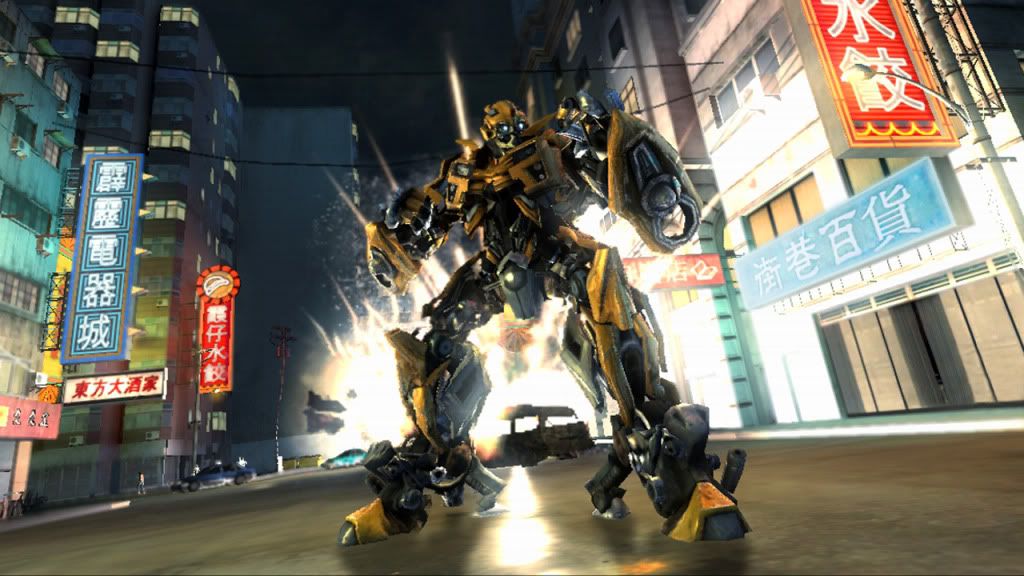


Transformers: Revenge of the Fallen Review

Imagine what it would be like to become a Transformer. Walking, jumping, and climbing in your humanoid form would be pretty familiar, and you could easily get the hang of whipping out your guns to blast enemies. Driving yourself around might be a bit awkward at first, and flying would be significantly trickier, but the real problems would come when you tried to transform. Shifting your physical form would be really disorienting, and it would take a while before you really mastered it.
Hitman

Hitman

Duisorem ipsum dolor sit amet, consectetuer adipiscing elit. Quisque sed felis. Aliquam sit amet felis. Mauris semper, velit semper laoreet dictum, quam diam dictum urna, nec placerat elit nisl in quam. Etiam augue pede, molestie eget, rhoncus at, convallis ut, ...
Hitman
Showing posts with label Games. Show all posts

Pro Evolution Soccer 2009

Pro Evolution Soccer 2009 is an improvement on last year's game, but this is a series that desperately needs a complete overhaul.

The Good

  • Simple, easy-to-pick-up gameplay
  • Champions League license with official teams and sponsors
  • New four-player online mode.

The Bad

  • Lack of improvement to core gameplay
  • Dated animation system looks stilted
  • Impoverished and laggy online play
  • Poor presentation and commentary.
Konami
KCET
Soccer Sim
Release:
Mar 17, 2009 »
ESRB:
Everyone

UK REVIEW--Although Pro Evolution Soccer fans bought last year's game in droves, it was unfortunately an all-time low for the series on the PlayStation 3. Poor graphics, dreadful presentation, and basic online play failed to make the most of the hardware, and it was a step back in gameplay terms. Pro Evolution Soccer 2009 doesn't completely redress the balance, but it's a step in the right direction, with new game modes, an improved editor, and even a Champions League licence. Additionally, this is a more enjoyable game to play thanks to its slower pace, more responsive control system, and simple passing mechanic. Unfortunately these are only small fixes, and though there's a solid game at the core, it's one that still fails to keep up with the times.

Pro Evolution Soccer 2009 includes the Champions League for the first time, complete with a TV-like audiovisual presentation.

Pro Evolution Soccer 2009 continues the series’ accessible and deep gameplay. A couple of key changes bring the gameplay back toward Pro Evo 6, which should make fans of the series feel right at home. The overall pace has been reduced this year, and the ball feels heavier, both of which mean that it's easier than ever to link passes. The game is also incredibly fluid when you're trying to link together through-balls and crosses, and moving the ball around generally feels more natural and instinctive than before. However, football is an unpredictable game, and this is something that Pro Evo 2009 really struggles to capture. Part of this is down to the animation system, which lets players change direction quickly but looks outdated and overly procedural. Run a player down the wing and you'll see his animation routine repeating over and over, and though a fast player can outrun a slower one, there's no real sense of physical tussling in midfield. This year's players bounce off of goalposts and one another, but famous players such as Rooney and Ronaldinho have none of their other defining physical qualities.

Although the gameplay has merely been given a face-lift, a number of game modes are completely new for this year. At the top of the list is the new Champions League mode, which means that Europe's biggest club tournament is included with some of its key teams and sponsors. This is quite a boon for Konami, who have long failed to secure any official competitions for the series. The Champions League mode is not only given prime position on this year's main menu, but it's also given the full TV-style presentational treatment. You get the same dramatically shot videos, replays, and banner ads that adorn the TV presentation of the competition, and most crucially, Handel’s “Zadok the Priest” features throughout. It's quite a refreshing change from previous games that have had an unofficial feel to them, but it's not perfect; only 13 teams from this year's competition are included in their official capacity. Key squads such as Arsenal and Chelsea are still called "North London" and "London FC," and are listed outside of the official Champions League roster.

In Become a Legend Mode, you control a single player throughout his football career.

The other major addition is the Become a Legend mode, in which you concentrate on an individual player rather than an entire team. You create your own player from scratch, choosing his height, weight, and facial details, even his celebration routines and likelihood of injury. You can also scan your own face if you have a PlayStation Eye camera, but the game just sticks your face on top of an existing model. This means that you need to adjust the skin tones on both the model and the photo to attain some sort of parity, and even then the results look oddly disjointed. That said, there's an absolute wealth of options to tweak, and it's great to see yourself score a goal in the game.

Ultimately, though, Become a Legend is a novel but rather boring take on the standard game. You spend most of the time running around off the ball, while midfield players will need to constantly chase down attackers while forwards will have to help score goals. Unlike the similar Be a Pro mode in FIFA 09, there's no incentive for actually performing your job on the pitch, given that you're not rewarded for your individual passing and tackling. If your team is scoring goals and winning games, then you'll be able to move to new teams, which means that your AI teammates become stronger along the way. The online version of Legend is much better because it does reward people for making successful passes and tackles, and the score multiplies the longer you hold on to the ball. The downside is that it only offers support for up to four players, and you have to play against an AI opponent.

The lack of official licences is something that Pro Evo fans should be used to by now, so it’s good that the edit mode has become even more extensive. You can manually edit everything from individual players and teams to stadiums and competitions, and if you spend a bit of time, you can update all of your favourite teams and leagues. Seeing "Yorkshire Orange" instead of "Hull City" can make any suspension of disbelief much harder, so it's worth doing. Even better, you can now import your own images and photos via USB memory stick or the PlayStation Eye camera. This still results in some funny-looking player faces, but it works well on club emblems.

Konami has clearly put some work into presentation this year, and though the results are still far from stylish, they are definitely trying. The menu system has been given a pop art/Gilbert & George overhaul that may look dated, but it certainly differentiates in the world of commercial sports games. The sound is atrocious, with generic music for the menus and what is without doubt the worst commentary yet. The duo of John Champion and Mark Lawrenson have unwisely tried to inject some humour into this year's proceedings, saying things like, "This match will end in defeat for one party, and in a party for the other." Even worse, they make frequent factual inaccuracies, praising defenders who haven't even touched the ball or midfielders who made passes that went straight to the opposing team. There are also no trophies for the PS3 version, which is a shame because the Xbox 360 version does feature achievements.

Camera and photo integration lets you put yourself in the game.

Last year's online mode was laggy, simple, and prone to connection dropout, and though it was updated postrelease, it never reached the state that it really should have. This year's game is better, but it's still lacking on both features and performance. The registration process involves separate IDs for both the game and Konami, and even when you get into the online mode, it's a confusing collection of menus and options. Servers are split by language, probably because you can text chat in the lobby before a game, and then each lobby has a maximum player count of 100. You can challenge individual players to matches or pair up automatically with the quick-match option, but getting into an online game still requires much more time and effort than it should. Lag is also a problem, with balls that act erratically and players that transport from one location to another. Strangely, this seemed to afflict the standard 1-versus-1 online mode rather than it did the four-player Legends mode.

Pro Evolution Soccer 2009 is a good game, but it's one that has significantly failed to evolve over the last few years. The new modes add some potential interest for owners of last year’s game, but the Champions League is just flashy dressing for a competition that still doesn't feature all of the official teams, and the Become a Legend mode is neither as feature-packed nor as fun to play as FIFA 09's equivalent. If you love Pro Evolution Soccer's gameplay and simple control system then this year's game is worth checking out, but everyone has a right to demand much more from Konami's increasingly stale series.

MLB 09: The Show Review

This superb video game adaptation of baseball knocks authenticity and realism out of the park.

The Good

  • Absolutely authentic in just about every possible way
  • Lifelike pitcher-batter duels
  • Realistic visuals and animations
  • Spectacularly addictive Road to the Show mode of play.

The Bad

  • Casual players might find the game too challenging at first
  • Loading times are long and frequent in Road to the Show mode.

There is no room at Cooperstown for baseball games yet, but if the hallowed hall of fame ever adds such a facility, you can guarantee that MLB 09: The Show will be one of the very first inductees. Everything here is brought to life in such an exacting, authentic fashion that you finish games feeling like you've actually spent time out on a real diamond. Driving gappers to the wall, painting corners to ring up Ks, and making running catches on the warning track deliver a sense of satisfaction typically reserved for Little League memories or big-league dreams. This outstanding look at the grand old game is not merely an adaptation of baseball; it is baseball in just about every conceivable way.

Pitcher-batter confrontations are more lifelike than ever.

Sony's San Diego Studios has done a tremendous job of building on last year's stellar effort, subtly improving most aspects of gameplay while not reinventing the wheel. Granted, this sequel isn't as much of an overhaul as it is a refinement. A fair bit of MLB 09 is a straight rehash of its 2008 predecessor. Modes of play remain fundamentally unchanged from when you left them 12 months ago, including exhibition, franchise, rivalry, online one-off games and leagues (online games are silky smooth, too), and the superb Road to the Show. Nothing here will force you to do so much as glance at the manual, although some extras have been tossed into the mix such as the intense Legend difficulty setting, salary arbitration and the waiver wire in franchise play, and flex scheduling and live drafts in online leagues. Controls also remain pretty much the same, with the addition of a handful of amenities such as the ability to quickly shift fielders on the fly and a more interactive baserunning interface in which you use the analog sticks to steal and retreat.

The look and sound of the game mimics last year's game as well. As with the above, though, nearly everything has been improved in one way or another. Presentation is virtually identical to a Major League TV broadcast, especially with quick game turned off so you can see all of the close-ups and slow-motion camerawork in-between plays. Player detail is amazing. Not only do faces look almost photorealistic, but the detail is also so sharp that you can recognize Major League stars from halfway across the diamond. Animations are superb. Hundreds of batting stances are depicted, and all of the fielding moves could have been taken directly from SportsCenter. Stadiums are packed with fine details. The grass looks so realistic that you might be tempted to mow it, and the infield dirt practically shimmers in the sunlight. Sound effects wrap right around you, with crowd noise and chants placing you on the diamond in the middle of a raucous stadium. The broadcast crew of Rex Hudler, Dave Campbell, and Matt Vasgerian do a good job of keeping you involved in the action, although they are a little too prone to repeating phrases and relying on stock sports cliches. Nevertheless, they provide good information, if not much in the way of cogent analysis.

The Road to the Show mode may take some commitment, but it's worth it to track every hit and fielding play in your player's quest for the Majors.

So you could fairly say that MLB 09 is the same as last year, only better--a lot better. The game on the field now feels almost entirely organic. Although the pitcher-batter duel in 2008 was very good, it now mimics real at-bats so accurately that it is uncanny. Ball physics are simply perfect. The ball comes off of the bat exactly as it should, depending totally on your timing, the location of your swing, and the location and movement of the pitch. When you hit a nubber, you know right away that you deserved to hit a nubber. When you crank one into the upper deck, you know right away that you deserved to crank one into the upper deck. Most at-bats are struggles when you're wielding the lumber. They play out just like in real baseball. You fight off tough pitches by getting a bit of wood on the ball, you can get jammed inside with bat-breaking results, and the pitcher will try to hoodwink you with garbage after getting ahead in the count. Drawing walks is now possible, too. You have to have a great eye and a lot of patience, but at least you can work your way aboard with a free pass now, which generally wasn't possible last year due to the supernatural acumen of the computer-controlled pitchers. Hitting mechanics are so well done that it's best to step into the box with all of the visual helpers switched off. In most baseball games, frills such as the strike box are necessary to get a handle on hitting the ball properly. Here, this graphical junk only interferes with reading pitches and taking cuts.

Pitching is equally brilliant and just as grueling. Every at-bat is a knock-down, drag-out scrap. Opposing hitters are extremely devious and very tough to fool. You can paint corners for Ks, although as in the real Majors, you're better off playing mind games and trying to mess up batters by varying pitch types and speeds. Opposing batters are a little easier to ring up than they were last year, given that their skills at reading pitches back then were so acute that it was just about impossible to get them to chase garbage even when they were behind in the count. Now you can get them to bite more often on pitches a little out of the zone, or freeze them with a heater down the pipe when they are expecting junk. It all adds up to an amazingly lifelike confrontation every time you hit the rubber.

Authenticity is also more pronounced in the field. When balls are hit to players, they now react according to their stats, not according to stock animations. The end result is that you never know what's going to happen. In most sports games, when you see a player going all out, you know that a highlight reel is about to unfold. Here, however, you might see that all-out run end up in a face-plant and the ball bouncing off of a glove. In the dozens and dozens of games that we played, not one play felt canned or preordained. Every single, every home run, every strikeout, every 6-4-3 double play, every routine catch in the outfield was its own wholly unique event. Establishing this random, anything-can-happen vibe is sort of the Holy Grail for sports-game developers, and as such, is rarely realized. Yet here the developers make it seem almost effortless. The visuals back all of this up. Players will bobble balls, pull off one-handed grabs in the infield, and make radically different catches in the outfield depending on the situation. You feel like you never see the same thing twice.

Player details are so finely realized that you can pick out stars such as Derek Jeter from halfway across the diamond.

Difficulty is about the only drawback to MLB 09 on the field. Even on the Rookie setting, hitting, pitching, and even some fielding can be tough. Stats generated are nearly dead-on in comparison to the real Majors, so remember that even the best players in the league hit their way aboard an average of a little more than three times in every 10 at-bats. Casual gamers are apt to be very frustrated in the early stages. Until you start getting your timing down and exercising a lot of patience, hitting is extremely hard. You certainly can't pick up the gamepad for the first time and start jacking balls over the fence like you can in MLB 2K9. The same goes for pitching because computer-controlled batters track your efforts and are quick to leap on pitches if you fall into a routine with type and location. Always leading off with that four-seam fastball is a recipe for disaster; your opponents will soon come to look for it and then crush it.

Fielding isn't nearly as hard to handle as either hitting or pitching, although it can be problematic at times. Reading the ball off of the bat is a little tough due to the camera angles. If you go down too low you can't see as much, and if you scale back all the way to allow for a broader view of the diamond, then the ball becomes a BB that you can easily lose sight of against the infield dirt. Another possible issue for some might be the adherence to old-fashioned controls. Whereas most sports games seem to be switching over to handling everything with the analog sticks, MLB 09 continues with tried-and-true button hitting for batting and either a meter or the classic "choose pitch and pick a location" for pitching. This makes the game feel a touch more "gamey" than the equivalent right-stick hitting and right-stick pitching in MLB 2K9, although the results on the field are so much more lifelike than the competition that the trade-off is more than worthwhile.

About the only aspect of MLB 09 that hasn't advanced in a significant way is the Road to the Show role-playing mode. Creating a player and trying to get him to the Major Leagues through controlling him during every plate appearance and fielding chance is every bit as captivating now as it was when it was first introduced two years ago, although it still has a huge problem with load times. It takes a good 20-30 seconds to load up a game for your player, and then another 20-30 seconds at the end of that game to process your results and get back to the main player menu. This sort of wait is readily endurable if you're getting into a game in exhibition or franchise modes, given that you're loading up a full nine-inning contest that generally takes around an hour to play. However, if you choose to play as a batter rather than a pitcher in Road to the Show, you're waiting all this time just to load up a handful of at-bats and a couple of fielding plays. And that's if you're lucky enough to be starting. If you're coming off of the bench, which you almost certainly will be in your first season or two, you often sit through these long loads to fire up a single pinch-hit appearance that wraps up in less than a minute. This gets rather frustrating, and it really bogs down progression through a season if you want to actually play and not simulate your player's actions.

New Yankee Stadium is present in all of its $1.3 billion glory.

With all of that said, Road to the Show is still amazingly addictive. Sure, it's a time sink. But it feels like you're really building a Major Leaguer one game at a time, earning training points through successes in games and buying skill-enhancing workouts. So it is well worth the commitment. New features such as training in the batting cages, and a revamped baserunning interface that involves reading signs from the third-base coach, further the illusion of being in a player's cleats. Interactive training is probably the best addition because it makes player careers more engaging. Coaches are also responsive to what is happening during games. Have a rough outing against a guy throwing curveballs, for instance, and don't be surprised if you soon get asked to spend some time in the cage with a pitcher throwing nothing but curves. The only complaint about training sessions is that there just aren't enough of them. You seem to get called into one only every couple of weeks, which doesn't give you enough time to focus on improving your skills.

MLB 09: The Show is more of a love letter to baseball than it is just another game. Of course, nothing will ever take the place of the real thing, but anyone with a serious fondness for the national pastime will find this an enthralling substitute.

Dynasty Warriors: Gundam 2 Hands-On

Do enough damage to robots to match the gross domestic product of a medium-sized nation in the latest Dynasty Warriors title.


If you've always been a fan of the Dynasty Warriors series but couldn't help feeling that ancient China could use some towering robots locked in fisticuffs, you were probably a fan of last year's spin-off, Dynasty Warriors: Gundam. Therefore you're probably equally excited about the upcoming sequel known appropriately as Dynasty Warriors: Gundam 2. Indeed, the world of hulking robots is as hostile as ever, because there are still battles to be fought, feuds to be settled, and gameplay updates to be added. We've been battling our way through a preview build of Dynasty Warriors: Gundam 2--our first look at it since October's Tokyo Game Show--in order to get a better feel for what to expect out of these updates when the game arrives on March 24.

Attack, robots, attack!

Dynasty Warriors: Gundam 2 offers a pair of different campaigns. Official mode is the default choice, allowing you to take part in storylines from various incarnations of the Gundam anime series, while Mission mode allows you to play fast and loose with the Gundam universe by taking its characters and mixing them up in new and different ways. Official mode begins with an initial selection of characters that includes Amuro Ray, Kamille Bidan, Judau Ashta, and Char Aznable--a roster that allows you to play the same missions from different sides of the good-versus-evil fence.

Jumping into your first mission reveals a style of gameplay that should feel very familiar to those who've invested any amount of time in the Dynasty Warriors series. In essence, you control a character who parades around a battlefield mowing down dozens upon dozens of similar-looking enemies in rapid, rhythmic succession. Combat is broken down into normal attacks, ranged charge attacks, and SP attacks that you pull off after filling up your SP gauge. The latter can be performed on the ground or in midair and vary in power depending on which SP level you're at or if you're on the brink of death and thus able to let out a hyper SP attack.

At certain points during the battle, you'll need to break from mashing the normal attack button to rush over to enemy commanders who provide a temporary spike in challenge. You'll need to use your full repertoire of moves on them and will often find yourself engaging in a quick-time event that prompts a series of button inputs when the two of you become deadlocked in battle. Successfully completing these missions lets you upgrade your character's level, unlock new characters, and find new parts that you can bring to your friendly neighborhood Gundam mechanic in order to upgrade your mobile suit.

Yes, the action itself ought to feel quite familiar to Dynasty Warriors loyalists. So where should you look to find new content in this sequel? The answer lies primarily in the aforementioned Mission mode. Hardcore Gundam fans ought to squeal with glee at the way this mode will let you submerge yourself in the anime's ecosystem of characters and mobile suits. It begins with a roster selection of such diverse names as Heero Yuy, Milliardo Peacecraft, Seabrook Arno, and Üso Ewin. From there, it's essentially a career mode for your Gundam pilot. The main lobby lets you choose from a variety of missions, alter your suit in the Mobile Suit Lab, dive into your character's stats and bio in the Lounge, and exchange messages with other pilots in the Terminal.

Expect to see lots of enemies on screen.

Missions in this mode are broken down into story missions that let you advance your character's plot, but they also include collection missions designed to let you find new parts, friendship missions for increasing your relationship with other pilots, and license missions to help unlock new classes of mobile suits. But if you'd rather just cause some ruckus, there's also a free mission option. Between the mission choice, pilot interactions, and customization options, Gundam nuts should enjoy this part of the game quite a bit. However, if you're not a Gundam nut and you think the name Char Aznable sounds like an ancient form of Aztec rugby, there's probably not a whole lot for you in Mission mode.

Dynasty Warriors: Gundam 2 is slated for release on March 24 on the Xbox 360, PlayStation 3, and PlayStation 2. You can expect to see our review right around then.

Need for Speed: Shift

Nfsshift1_5

Electronic Arts' Need for Speed series has a long, storied history, dating back to the 3D0 in 1994. Three new games are currently in development, distinct titles that EA hopes will appeal to different types of racing fans.

Need for Speed: Shift is aimed squarely at simulator buffs, emulating an authentic racing experience with complex physics, fully realized performance modeling and a selection of high-performance vehicles tearing around closed-track environments.

I recently had a chance to test drive an early build of the PC version, experiencing all the joys of careening into stationary objects at mind-numbing speeds. Even in this early state, it's an impressive ride.

Need or Speed: Shift is being developed by Slightly Mad Studios, whose previous titles (under the moniker "Blimey! Games") include racing simulators like GT Legends and GTR 2 -- games that are generally ranked among the upper echelons of racing simulators.

In Shift, subtle details go a long way toward enhancing the racing experience. Every car features a fully modeled interior, which we are told will be accurate down to the knobs on the Audi RS4's radio or the distinct logo on the Corvette's speedometer. Performance varies wildly among the vehicles, with heavy, rear-wheel drive behemoths like the Shelby Mustang demanding a dramatically different approach to driving than the nimble, comparatively petite Lotus.

Nfsshift2_2

Should you choose to race with a view from inside the cockpit, you'll find a fully animated driver, and an involved driving experience. A helmet-mounted camera will react to your actions -- accelerate, and the camera will pivot back, while braking suddenly will cause it to dip forward. Once you've really picked up speed, you'll experience tunnel vision, blurring your surroundings and bringing the camera's focus onto the road.

These camera effects extend to moments when you're not racing. Hit a wall and you'll experience a moment of disorientation: The camera will jostle, and your vision will blur, with effects intensifying for your more spectacular screw-ups.

Shift also features full damage modeling, which I saw in its earliest stages. The occasional dent or dirt collecting on the hood might mar the paint finish, but serious mishaps will ultimately affect the performance attributes of your vehicle. If you choose to sit inside the cockpit, you might find your vision suddenly obscured by a cracked windshield or a raised, crumpled hood -- perfect for getting a peek at the fully modeled engine rumbling underneath. Should you plow into a wall while driving a supercar at 300 mph, don't expect to bounce back into the race.

While watching gorgeous, expensive automobiles crumple is quite a bit of fun, Shift is ultimately about racing. The experience can be scaled for simulator fans of all skill levels. A driving line on the track will show you the ideal route to take; it is updated dynamically to give you suggestions, based on your current speed.

If the line is blue, drive a little faster. Once the line goes red, start mashing the brakes or be prepared to hit something heavy. Braver, experienced racing fans can tweak the game to their liking, from shutting off the driving line to disabling safeguards like traction control or the anti-lock braking system, unleashing the full capabilities of their racing machines.

Computerized competitors will adapt to your performance as you race. Aggressive players will encounter racers who are more than happy to nudge them into a guardrail, while civilized drivers will be left alone. Your automated opponents will also make the occasional mistake -- these can range from locking up their brakes to causing multiple-car pileups, encouraging racers to keep an eye on their surroundings. Difficulty will scale between matches, so those players (like myself) who regularly limp along at the back of the pack will be able to compete, while racing-sim aficionados will face consistent challenges.

The game will ship with somewhere between 60 and 100 customizable cars, and an unspecified number of tracks that will feature full weather effects that affect your performance. These will range from official circuit tracks like Brands Hatch, to fictional courses in real-world locations like London. These are all closed-road tracks, so don't expect police chases or civilian automobiles.

Need for Speed: Shift is scheduled to arrive this fall for PC, Xbox 360, PlayStation 3 and PSP.

Killzone 2 Review

Killzone 2 boasts amazing visuals, an intense campaign, and extraordinary online play that will keep you coming back for more.

The Good

  • Well-paced campaign keeps you in the thick of action
  • Great online play constantly rewards you
  • Intricate, balanced multiplayer maps
  • Weapons are beefy and fun to shoot
  • Visually stunning, both technically and artistically.

The Bad

  • Forgettable story and characters
  • Tacked-on motion controls.

No one could have suspected that the sequel to 2004's Killzone would be this good. Killzone 2 is a tremendous package, offering an exciting campaign and terrific competitive online play, neither of which create new paradigms for first-person shooters, but rather set new standards in subtle but significant ways. From groundbreaking visuals to well-crafted multiplayer maps, most of Killzone 2's individual elements stand out in a crowded genre, making its meager attempts at storytelling easy to ignore. PlayStation 3 owners looking for a shooter to keep them busy for the rest of 2009 and beyond need look no further: The fierce action will keep you glued to your television screen for some time to come.

The M82: Is there nothing it can't do?

What makes Killzone 2's single-player campaign so much fun? First and foremost, the weapons are a lot of fun to shoot, even the standard assault rifles that form the core of your loadout. The M82's effective scope makes zooming in on your target a breeze, yet this rifle is effective at close range as well, establishing itself from the beginning as a formidable firearm. The LS13 shotgun is also powerful and rewarding to fire; though you may only shoot off a foe's helmet with other weapons, you'll watch entire heads explode with a single blast from this close-range powerhouse. The bolt gun is another favorite, skewering enemy soldiers onto surfaces and exploding a short moment later. Though you're traversing a sci-fi setting, your weapons are decidedly modern-day, from the sniper rifle to the vicious flamethrower, with one exception: the lightning gun. This mighty instrument showers enemies with overpowering jolts of electricity, and though it's not available for long, it makes short work of robotic and humanoid foes. Each of these weapons feels just right; fantastic spurts of blood, outstanding animations, exquisitely detailed weapon models, and explosive sound effects fuse seamlessly and give a satisfying sense of impact every time you land a shot.

Although there's a great variety of weaponry, you won't encounter that many different kinds of enemies as you fight your way across the war-torn landscapes of the planet Helghan. As in the original Killzone, your enemies consist largely of Helghast soldiers, yet though this limited selection led to monotony in the past, an assortment of factors in the sequel hold tedium at bay. The action is constantly pushing forward, leading you from one quality scripted event to the next and pitting you against bright AI opponents that have a remarkable grasp of battlefield tactics. These soldiers put up a fight and exhibit authentic behavior as you rain bullets on them. If you set your sights on a soldier peeking from behind cover and fire off a few rounds in that direction, he'll patiently wait until all signs of fire have vanished. Helghast will flank you and shoot blindly from behind cover, and should you toss a grenade in their direction, they'll quickly scatter. You'll normally be fighting alongside a computer-controlled teammate or even entire squads of fellow infantry. Enemy AI is just as concerned with your comrades as it is with you, so you'll never feel as if you have a bull's-eye plastered on your forehead, as is common with many other team-based shooters. As a result, Killzone 2's thrilling large-scale battles unfold dynamically and offer a legitimate challenge while rarely feeling unfair--a frustrating rocket-heavy final battle serving as the only exception.

Some excellent turret sequences and other segments also provide welcome variations on the shooting theme. At one point, you'll climb into a robotic shell and mow down infantry and tanks with machine gun fire and rockets. The way your transparent protective shield exhibits cracks as you take damage and the remarkable fire and smoke effects that light up the screen add to the excitement of the level. In another fun and visually stunning sequence, you'll use an antiaircraft turret to take down squadrons of enemy fighters. Even operating a standard turret is more appealing than you would expect, which is a result of great map design and well-scripted enemy entrances. If you're just using your standard arsenal, missions are diverse and engaging. You'll take aim at tanks (and in one boss fight, a hovering aircraft) using Killzone 2's potent rocket launcher, and you'll fight your way through a besieged air base in which winding corridors and intersecting passages have you battling multiple enemies on multiple levels.

Most levels take their cue from the usual first-person shooter formulas, and though it takes place in the spacefaring future, Killzone 2 feels more akin to a modern-day day FPS by way of its standard weapons and mostly humanoid enemies. It's an interesting blend of two disparate sensibilities that works far better than in the original, and it's further ripened by gameplay touches that feel authentic within that framework. Movement and turning speeds have a real feeling of weight, which is appropriate considering the heavy armor burdening you. This can make the controls feel somewhat sluggish at first, given that you take a moment to gather momentum. It doesn't take long to get accustomed to this sense of overall bulkiness, though, and it's consistently delivered across multiple mechanics. For example, when you jump, the way that you bend into the leap and cushion the landing with another slight crouch feels surprisingly realistic. That weight also informs movement in and out of cover. Killzone 2's cover system is solid, and it never removes you from a first-person viewpoint. Though some objects can obscure your view if you try to take potshots from behind them, sticking to cover and leaning out from behind walls is generally effective and intuitive.

This armored suit is the ultimate death machine.

Whether you go for a pop-and-shoot approach or just gun your way through, the mission design keeps you constantly moving from one objective to the next. The quick pace is one of Killzone 2's finest facets; battles don't wear on too long, and they aren't so brief as to be anticlimactic. Like many other shooters, mission objectives often involve turning a crank or pushing a button. In Killzone 2, this may mean rotating the controller to simulate the onscreen activity. These moments feel unnecessary and ironically disrupt the sense of immersion, but as tacked-on as they are, the actions are too brief to be especially annoying. You'll also use your gamepad's motion sensitivity to stabilize the sniper rifle, though the implementation here is subtle and therefore relatively harmless.

It's a real pity that there is so little context for the exceptional action. If you're familiar with the original Killzone, you'll at least have an idea why the ISA (International Strategic Alliance) is attacking the Helghast homeworld; if not, it's clear that as Thomas Sevchenko, you are on the side of the good guys--just not clear why they are the good guys. The dialogue is rudimentary (a discussion regarding sandwiches jumps immediately to mind), the characters forgettable, and the plot serves purely as a thin framework to move you from one environment to the next. Yet the cutscenes are top-notch, and unlike their counterparts in fellow PS3 shooter Haze, there's nothing intrinsically offensive or wearisome about the fist-pumping grunts at the core of the story. The story isn't deep or involving--it's just there, neither enhancing nor diminishing Killzone 2's action.

That action is enhanced by groundbreaking visuals that elevate Killzone 2 to the head of its class. Both technically and artistically, this is a real stunner. You'll first notice the obvious expressions of its technical prowess: environments jam-packed with objects and textured architectural details, pipes and crumbling rebar jutting from dilapidated buildings, and gorgeous lighting that drenches market squares and sandy battlefields with an incandescent glow. As you peel away the visual layers, your appreciation will only grow. Soldier animations are the best in the genre: Enemies move so fluidly during battle, and shift from cover to firing stance so smoothly, it's clear that meticulous attention was given to making each limb move authentically. Even the smallest details are striking. Raging fires react to the wind as it blows through the level, lightning flashes across the gloomy skies, and billows of smoke so thick you could choke on them cloud your view--but never so much as to be a gameplay annoyance.

The environments are dripping with grim ambience.

These visuals coalesce beautifully to give Killzone 2 a cohesive look that relies as much on its art design as it does on its technology. A subtle grain filter, a good amount of motion blur, and deep color saturation give most levels a dank, overcast ambience, and asymmetrical architecture and other small stylistic touches make Helghan feel more like a grim alternate-universe Earth than a completely foreign world. The sound design offers an equally intense palette. Explosions are obnoxiously loud, and the din of gunfire spreads across the map. The largest battles, such as one that rages across a decrepit bridge, sound intensely chaotic, and the crack of lightning bolts on Blood Gracht may cause you to jump out of your seat. The stormy soundtrack rages at all the right moments but gets a bit overwrought, which befits the hammy voice acting more than it does the layered sound effects.

Although the campaign is over in eight or nine hours, many levels are eminently replayable thanks to tough enemy AI and multiple difficulty levels, and the game makes it easy to revisit specific sequences within its mission menu. But what gives this shooter legs is its fantastic online play, a fun and competitive extravaganza that issues a constant stream of benefits. Like the most recent Call of Duty games, Killzone 2 rewards you with bonuses as you play, which in this case can mean new weapons, extra grenades awarded upon respawning, and most intriguingly, entire classes. This is done not only via a leveling system that pushes you ever closer to the next reward, but also with ribbons earned by completing specific tasks, such as getting a certain percentage of your team's kills. These bonuses are earned separately from leveling, which makes for two layers of online play enhancements to keep you ever addicted.

These dividends flow in a seemingly endless current, though they aren't the only facet of online play that will keep you gripping your controller; the team-based gameplay itself is outstanding, which serves as reason enough to stick with Killzone 2. The modes themselves offer few surprises, what with variants on Team Deathmatch (Bodycount), Conquest (Capture and Hold), and Capture the Flag (Search and Retrieve), among others. Rather, matches are unique because these modes are strung seamlessly together, forcing teams to move from one objective to the next with barely a breather in-between. Up to five modes mesh into a single game, which keeps teams on their toes and spreads hotbeds of action about the maps. In a single match, you're likely to band with teammates in an exposed courtyard, navigate tight walkways as battles rage in the artificial gulley just beyond, and defend an objective in a claustrophobic alcove. It's unlikely that you'll have trouble finding players online to join you in one of Killzone 2's 32-player engagements, but should you be so inclined, you can fill out the games that you host with up to 15 AI-controlled bots. You can even practice offline in one-off matches with those same bots if you prefer.

The eight maps included are exceptional, largely because they are flexible enough to make every mode feel like a natural fit for the precise layouts. Aspects such as the varying spawn points of the propaganda speaker in Search and Retrieve, and the vulnerable locations of capture points in Capture and Hold, provide focused hot spots and send you to every nook and cranny of the maps. Be prepared to think vertically because the pathways wind up stairwells, through hidden tunnels, and across balconied walkways. The addition of techniques available to each of Killzone 2's seven classes makes the ensuing action even more dynamic. An engineer's turrets can make Pyrrhus Rise's natural chokepoints even more treacherous, whereas a cloaked enemy may pounce on you as you navigate Tharsis Depot's constricted walkways. All the while, visual flourishes such as floating embers on Visari Hammer and distant artillery fire on Salamun Market keep the mood oppressive.

Online play offers an embarrassment of rewards.

Additional features flesh out the robust online play. You can join other teammates in a squad, a la Battlefield 2 and Enemy Territory, a feature that lets you coordinate attacks with ease. Full support for clans and clan challenges should make Killzone 2 a natural destination for competitive teams, and you can use killzone.com to schedule clan matches and tournaments. But whether you're a lone wolf or a clan enthusiast, you'll be happy to find a mostly smooth online experience, with only rare and short bouts of visual slowdown and online lag. In light of this extraordinary suite of online options, it's a pity that there is no cooperative play, and the single-player campaign seems ripe for such an addition, given that you're usually accompanied by an AI teammate.

You'll have to look to the inevitable Killzone 3 to find out if developer Guerilla can dig any diamonds out of this series' rough narrative. Otherwise, Killzone 2 is an exceptional first-person shooter, not because it does anything particularly new, but because it does everything extraordinarily well. There's certainly no doubting its graphical superiority, but though its moody visuals invite incessant superlatives, it's the tight, electric action that will make this an off- and online haven.

Video Preview :


Tom Clancy's HAWX

From Rainbow Six to Ghost Recon and even Splinter Cell, Tom Clancy games have a long lineage of strong online multiplayer. But one key difference between these games and the upcoming Tom Clancy's HAWX is that in this game, your feet won't be planted safely on the ground. Instead, battles are waged thousands of feet above the earth with the latest in fighter jet technology. However, while the altitude may be different, you'll still find that most familiar of online multiplayer features: Team Deathmatch. We recently had the good fortune of being shot out of the sky by members of Ubisoft during a round of multiplayer matches this past week, and we're happy to say we had a pretty fun time with it.

Right from the outset, we should probably mention that HAWX's multiplayer capabilities aren't limited to the competitive variety. We've already covered how the entire game can be played cooperatively, but this is the first time we've been able to go at it in a less civil environment. Essentially, multiplayer is a spiced-up version of Team Deathmatch. You split up into a blue team and a green team, and the basic objective is a simple one: be the first team to reach a predetermined number of kills.

But of course the path to that goal isn't always an easy one. It's not simply a matter of routine dogfighting--following enemy jets, locking on, and firing a missile at them. What happens over the course of the game is that as you rack up kill streaks, you unlock support items for your team that alter the game with a sudden shift in your team's favor. You can suppress the other team's radar in order to remove any trace of your team's presence from the screens of enemies, send in a repair drone to bring the integrity of your jets back to factory condition, impose an altitude limit on the other team, restrict what sort of missiles the other team can fire, and so on. In our experience, the game does a good job of letting you know which support items are in effect so that it doesn't feel like a storm of random upgrades.

Whether triggering support items or collecting individual kills, everything you do in multiplayer earns you XP points (which can also be done in single-player, and the points go toward the same overall total). However, the fastest way to earn more XP is by completing challenges. These are feats performed throughout the game that earn you XP in bunches, and they include easy objectives, such as winning five total Team DM games, and not-so-easy objectives, such as deflecting 10 missiles from your team's ace. The benefit of XP is that you'll unlock new ranks, weapons, and jets for use in these matches, so while you'll start in an ancient, practically steampunk Russian MiG-21, you'll eventually get to ride in the much nicer F-22 Raptor or B-2 Spirit. The whole rank-and-reward process feels compelling, almost like Call of Duty 4 set in the sky.

Another fun feature that looks like it should add some personality to different matches is the way your performance will be displayed in the form of various post-match awards. These isolate the top performers in various categories and, conversely, those who didn't quite pull their weight. Some of the obvious awards include Assassin, the player who does the most damage during a match, and Life Guard, the player who deflects the most missiles. Other awards include Iceman, the player who recovers from a stall the closest to the ground, and Stuntman, the player who crashes the most. These awards don't have any effect on gameplay, but they do provide a nice chance to razz teammates after a match.

HAWX Video Preview :


Valuebux!