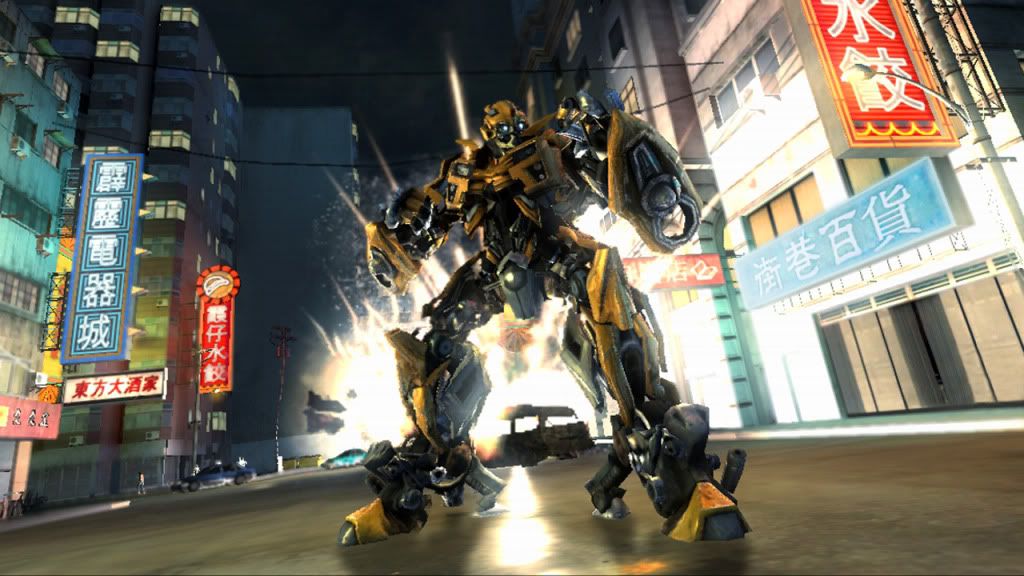


Transformers: Revenge of the Fallen Review

Imagine what it would be like to become a Transformer. Walking, jumping, and climbing in your humanoid form would be pretty familiar, and you could easily get the hang of whipping out your guns to blast enemies. Driving yourself around might be a bit awkward at first, and flying would be significantly trickier, but the real problems would come when you tried to transform. Shifting your physical form would be really disorienting, and it would take a while before you really mastered it.
Hitman

Hitman

Duisorem ipsum dolor sit amet, consectetuer adipiscing elit. Quisque sed felis. Aliquam sit amet felis. Mauris semper, velit semper laoreet dictum, quam diam dictum urna, nec placerat elit nisl in quam. Etiam augue pede, molestie eget, rhoncus at, convallis ut, ...
Hitman
Showing posts with label PSP. Show all posts

Air Conflicts

The long drought of WWII air combat sims on the PSP has finally come to an end. We go hands on with Air Conflicts.

When you think of World War II air combat games, Sony's PSP might not be the first gaming platform that pops into your head. After all, flight combat games have long been the dominion of the PC (and to a lesser degree, consoles). Still, that hasn't stopped developer Graffiti Entertainment from bringing the upcoming Air Conflicts: Aces of World War II to the handheld. We had a chance to try this game out recently to get a feel for how the genre translates to the small screen.

Off we go into the wide blue yonder!

The core of Air Conflict's modes is a campaign mode, where you can join one of four World War II forces: Germany, Britain, USA, and USSR. Each of the 13 campaigns is composed of a number of missions (240 total in the game) that are inspired by actual WWII combat actions, but all revolve around showing your worth behind the flight stick.

Campaign missions typically start out with a quick tutorial--the USAAF campaign we played first had us piloting our plane through a series of in-air waypoints. Soon enough, however, the action picks up and you'll be engaging the enemy in toe-to-toe dogfights. Right out of the box, Air Conflicts is a very difficult game, even on the novice difficulty setting. Part of the problem is the small screen size, and the even smaller aiming reticle that indicates where your bullets will strike. Compounding that is the very difficult nature of dogfights in general--you've got to lead your opponent, anticipating where the bullets will strike him when they reach his position. The aiming cursor helps a bit here by glowing red when you have an opponent correctly lined up, but it's very small, and the enemy AI is tenacious enough to put up a good fight even at the lowest difficulty level.

Mission varieties include escort missions, which have you protecting bombers as they look to destroy strategic targets; patrols, where you're looking to blast any enemy aircraft out of the skies; and bombing runs, where you're piloting the bomber and looking to take out targets yourself.

The game's varied missions demand a big roster of planes to pilot, and that's one aspect where Air Conflicts delivers, with 17 historically authentic planes. Sample aircraft include the Spitfire, the P-51 Mustang, the B-17 "Flying Fortress," the Ju-87 Stuka, and many more. Many of these planes have their specific uses--for instance, the B-17 is a bomber--but they all have strengths and weaknesses. For instance, while the aforementioned B-17 isn't very agile, its multiple machine-gun postings (front and rear) make it a formidable opponent against enemy fighters. Different planes have different weapon loadouts as well, and because you'll often have a choice of aircraft before beginning a mission, you'll want to make sure you choose the right plane for the job.

To its credit, Air Conflicts' realistic settings are counterbalanced by relatively simplistic controls. The left and right triggers control throttle, the analog stick is used to steer your plane, and the face buttons are used to fire various weapons (X for machine gun, triangle for missiles, square for bombs). Still, the game's AI is formidable, so don't be surprised if you're shot out of the sky multiple times in the early goings of the game. Interestingly, a failed mission doesn't necessarily mean the end of a campaign--sometimes you'll just move on to the next mission, even if you failed the previous mission. The game will also include multiplayer, with support for up to eight players to connect and battle it out.

Graphically, Air Conflicts holds up decently. The plane models are consistently nice, and some of the explosions in the game, particularly those of damaged planes crashing to the ground, are well done. We just wish that a game that's already presented on a small screen would take pity on folks with bad eyes--the miniscule aiming reticle and barely legible mission text might have you reaching for your glasses (or considering a prescription). Still, if you're upset over the WWII-flight-combat-game hole in your PSP library, Air Conflicts just might be your thing. Look for more on the game in the coming weeks.


Air Conflicts: Aces of World War II

Graffiti Entertainment
Cowboy Rodeo
WWII Flight Sim
Release:
Apr 2, 2009
ESRB:
Teen

Pro Evolution Soccer 2009

Pro Evolution Soccer 2009 is an improvement on last year's game, but this is a series that desperately needs a complete overhaul.

The Good

  • Simple, easy-to-pick-up gameplay
  • Champions League license with official teams and sponsors
  • New four-player online mode.

The Bad

  • Lack of improvement to core gameplay
  • Dated animation system looks stilted
  • Impoverished and laggy online play
  • Poor presentation and commentary.
Konami
KCET
Soccer Sim
Release:
Mar 17, 2009 »
ESRB:
Everyone

UK REVIEW--Although Pro Evolution Soccer fans bought last year's game in droves, it was unfortunately an all-time low for the series on the PlayStation 3. Poor graphics, dreadful presentation, and basic online play failed to make the most of the hardware, and it was a step back in gameplay terms. Pro Evolution Soccer 2009 doesn't completely redress the balance, but it's a step in the right direction, with new game modes, an improved editor, and even a Champions League licence. Additionally, this is a more enjoyable game to play thanks to its slower pace, more responsive control system, and simple passing mechanic. Unfortunately these are only small fixes, and though there's a solid game at the core, it's one that still fails to keep up with the times.

Pro Evolution Soccer 2009 includes the Champions League for the first time, complete with a TV-like audiovisual presentation.

Pro Evolution Soccer 2009 continues the series’ accessible and deep gameplay. A couple of key changes bring the gameplay back toward Pro Evo 6, which should make fans of the series feel right at home. The overall pace has been reduced this year, and the ball feels heavier, both of which mean that it's easier than ever to link passes. The game is also incredibly fluid when you're trying to link together through-balls and crosses, and moving the ball around generally feels more natural and instinctive than before. However, football is an unpredictable game, and this is something that Pro Evo 2009 really struggles to capture. Part of this is down to the animation system, which lets players change direction quickly but looks outdated and overly procedural. Run a player down the wing and you'll see his animation routine repeating over and over, and though a fast player can outrun a slower one, there's no real sense of physical tussling in midfield. This year's players bounce off of goalposts and one another, but famous players such as Rooney and Ronaldinho have none of their other defining physical qualities.

Although the gameplay has merely been given a face-lift, a number of game modes are completely new for this year. At the top of the list is the new Champions League mode, which means that Europe's biggest club tournament is included with some of its key teams and sponsors. This is quite a boon for Konami, who have long failed to secure any official competitions for the series. The Champions League mode is not only given prime position on this year's main menu, but it's also given the full TV-style presentational treatment. You get the same dramatically shot videos, replays, and banner ads that adorn the TV presentation of the competition, and most crucially, Handel’s “Zadok the Priest” features throughout. It's quite a refreshing change from previous games that have had an unofficial feel to them, but it's not perfect; only 13 teams from this year's competition are included in their official capacity. Key squads such as Arsenal and Chelsea are still called "North London" and "London FC," and are listed outside of the official Champions League roster.

In Become a Legend Mode, you control a single player throughout his football career.

The other major addition is the Become a Legend mode, in which you concentrate on an individual player rather than an entire team. You create your own player from scratch, choosing his height, weight, and facial details, even his celebration routines and likelihood of injury. You can also scan your own face if you have a PlayStation Eye camera, but the game just sticks your face on top of an existing model. This means that you need to adjust the skin tones on both the model and the photo to attain some sort of parity, and even then the results look oddly disjointed. That said, there's an absolute wealth of options to tweak, and it's great to see yourself score a goal in the game.

Ultimately, though, Become a Legend is a novel but rather boring take on the standard game. You spend most of the time running around off the ball, while midfield players will need to constantly chase down attackers while forwards will have to help score goals. Unlike the similar Be a Pro mode in FIFA 09, there's no incentive for actually performing your job on the pitch, given that you're not rewarded for your individual passing and tackling. If your team is scoring goals and winning games, then you'll be able to move to new teams, which means that your AI teammates become stronger along the way. The online version of Legend is much better because it does reward people for making successful passes and tackles, and the score multiplies the longer you hold on to the ball. The downside is that it only offers support for up to four players, and you have to play against an AI opponent.

The lack of official licences is something that Pro Evo fans should be used to by now, so it’s good that the edit mode has become even more extensive. You can manually edit everything from individual players and teams to stadiums and competitions, and if you spend a bit of time, you can update all of your favourite teams and leagues. Seeing "Yorkshire Orange" instead of "Hull City" can make any suspension of disbelief much harder, so it's worth doing. Even better, you can now import your own images and photos via USB memory stick or the PlayStation Eye camera. This still results in some funny-looking player faces, but it works well on club emblems.

Konami has clearly put some work into presentation this year, and though the results are still far from stylish, they are definitely trying. The menu system has been given a pop art/Gilbert & George overhaul that may look dated, but it certainly differentiates in the world of commercial sports games. The sound is atrocious, with generic music for the menus and what is without doubt the worst commentary yet. The duo of John Champion and Mark Lawrenson have unwisely tried to inject some humour into this year's proceedings, saying things like, "This match will end in defeat for one party, and in a party for the other." Even worse, they make frequent factual inaccuracies, praising defenders who haven't even touched the ball or midfielders who made passes that went straight to the opposing team. There are also no trophies for the PS3 version, which is a shame because the Xbox 360 version does feature achievements.

Camera and photo integration lets you put yourself in the game.

Last year's online mode was laggy, simple, and prone to connection dropout, and though it was updated postrelease, it never reached the state that it really should have. This year's game is better, but it's still lacking on both features and performance. The registration process involves separate IDs for both the game and Konami, and even when you get into the online mode, it's a confusing collection of menus and options. Servers are split by language, probably because you can text chat in the lobby before a game, and then each lobby has a maximum player count of 100. You can challenge individual players to matches or pair up automatically with the quick-match option, but getting into an online game still requires much more time and effort than it should. Lag is also a problem, with balls that act erratically and players that transport from one location to another. Strangely, this seemed to afflict the standard 1-versus-1 online mode rather than it did the four-player Legends mode.

Pro Evolution Soccer 2009 is a good game, but it's one that has significantly failed to evolve over the last few years. The new modes add some potential interest for owners of last year’s game, but the Champions League is just flashy dressing for a competition that still doesn't feature all of the official teams, and the Become a Legend mode is neither as feature-packed nor as fun to play as FIFA 09's equivalent. If you love Pro Evolution Soccer's gameplay and simple control system then this year's game is worth checking out, but everyone has a right to demand much more from Konami's increasingly stale series.

Need for Speed: Shift

Nfsshift1_5

Electronic Arts' Need for Speed series has a long, storied history, dating back to the 3D0 in 1994. Three new games are currently in development, distinct titles that EA hopes will appeal to different types of racing fans.

Need for Speed: Shift is aimed squarely at simulator buffs, emulating an authentic racing experience with complex physics, fully realized performance modeling and a selection of high-performance vehicles tearing around closed-track environments.

I recently had a chance to test drive an early build of the PC version, experiencing all the joys of careening into stationary objects at mind-numbing speeds. Even in this early state, it's an impressive ride.

Need or Speed: Shift is being developed by Slightly Mad Studios, whose previous titles (under the moniker "Blimey! Games") include racing simulators like GT Legends and GTR 2 -- games that are generally ranked among the upper echelons of racing simulators.

In Shift, subtle details go a long way toward enhancing the racing experience. Every car features a fully modeled interior, which we are told will be accurate down to the knobs on the Audi RS4's radio or the distinct logo on the Corvette's speedometer. Performance varies wildly among the vehicles, with heavy, rear-wheel drive behemoths like the Shelby Mustang demanding a dramatically different approach to driving than the nimble, comparatively petite Lotus.

Nfsshift2_2

Should you choose to race with a view from inside the cockpit, you'll find a fully animated driver, and an involved driving experience. A helmet-mounted camera will react to your actions -- accelerate, and the camera will pivot back, while braking suddenly will cause it to dip forward. Once you've really picked up speed, you'll experience tunnel vision, blurring your surroundings and bringing the camera's focus onto the road.

These camera effects extend to moments when you're not racing. Hit a wall and you'll experience a moment of disorientation: The camera will jostle, and your vision will blur, with effects intensifying for your more spectacular screw-ups.

Shift also features full damage modeling, which I saw in its earliest stages. The occasional dent or dirt collecting on the hood might mar the paint finish, but serious mishaps will ultimately affect the performance attributes of your vehicle. If you choose to sit inside the cockpit, you might find your vision suddenly obscured by a cracked windshield or a raised, crumpled hood -- perfect for getting a peek at the fully modeled engine rumbling underneath. Should you plow into a wall while driving a supercar at 300 mph, don't expect to bounce back into the race.

While watching gorgeous, expensive automobiles crumple is quite a bit of fun, Shift is ultimately about racing. The experience can be scaled for simulator fans of all skill levels. A driving line on the track will show you the ideal route to take; it is updated dynamically to give you suggestions, based on your current speed.

If the line is blue, drive a little faster. Once the line goes red, start mashing the brakes or be prepared to hit something heavy. Braver, experienced racing fans can tweak the game to their liking, from shutting off the driving line to disabling safeguards like traction control or the anti-lock braking system, unleashing the full capabilities of their racing machines.

Computerized competitors will adapt to your performance as you race. Aggressive players will encounter racers who are more than happy to nudge them into a guardrail, while civilized drivers will be left alone. Your automated opponents will also make the occasional mistake -- these can range from locking up their brakes to causing multiple-car pileups, encouraging racers to keep an eye on their surroundings. Difficulty will scale between matches, so those players (like myself) who regularly limp along at the back of the pack will be able to compete, while racing-sim aficionados will face consistent challenges.

The game will ship with somewhere between 60 and 100 customizable cars, and an unspecified number of tracks that will feature full weather effects that affect your performance. These will range from official circuit tracks like Brands Hatch, to fictional courses in real-world locations like London. These are all closed-road tracks, so don't expect police chases or civilian automobiles.

Need for Speed: Shift is scheduled to arrive this fall for PC, Xbox 360, PlayStation 3 and PSP.

Patapon


The Good

  • Superb art design
  • Innovative rhythm-based real-time strategy gameplay
  • Some varied and memorable level designs
  • Plenty of loot to collect for your army
  • Excellent value for money.

The Bad

  • No multiplayer support
  • Replaying hunt levels gets old after a while.


Like Puzzle Quest before it, Patapon is a game that grabs key features from existing genres, squishes them together like different-colored balls of Play-Doh, and then turns them into something far more special than you might expect. For example, if you combined a ball of red and ball of blue you might expect to get a big lump of purple, while a rainbow-colored re-creation of the Venus de Milo would seem unlikely. But Patapon is just that special. Puzzle Quest's nontoxic, nonstaining ingredients included a Bejeweled-style puzzle component used for combat, as well as a character advancement system and storyline that belonged in a role-playing game. Patapon's recipe, on the other hand, blends rhythm-based controls with a horizontally scrolling real-time strategy game. Then--as if that combo wasn't already enticing enough--it sprinkles plenty of RPG-style gear collection and some fabulous visuals from French artist Rolito on top. In short, Patapon is unlike any game that has come before it, and with a retail price that's half of what many PSP games sell for, our recommendation of this ingenious recipe that has been masterfully realized is a no-brainer.

Developed by Interlink, the same studio responsible for 2006's Loco Roco, Patapon casts you in the role of a deity who is worshipped by the titular tribe. The Patapon have fallen on hard times since being forced from their homeland by the evil Zigaton army, and you're their best shot at ever reclaiming it. Since you've showed up in their hour of need, you've also been tasked with leading the tribe to a mysterious place called Earthend so that they might gaze upon a sacred object known simply as "IT." The Patapon are a tribe of adept warriors, but they're clueless without someone to lead them and won't do anything without first being told to by The Almighty. That's you.

You interact with the tribe using a set of four battle drums, which are mapped to the PSP's face buttons. Orders must be given to the tribe in time with a beat that's constant throughout every mission using different sequences of four drum notes. Simple orders, such as "advance" and "attack," are enough to get you through the early levels. But you'll learn others, such as "charge," "defend," and "retreat" as you progress through the game. Furthermore, you'll learn to use your godlike powers to perform four different weather-changing miracles that can be used to give your archers' arrows a tailwind or to unsettle a boss with an earthquake among other things.

Archers, which are known as "Yumipon" in-game, are one of six different unit types that you'll be adding to your army's ranks as you battle your way toward Earthend. The others, which also have different names that will mean nothing to you, are essentially foot soldiers, spearmen, cavalry, musicians (whose tubalike instruments launch deadly projectiles), and heavies armed with oversized maces or hammers. You can only take three different unit types with you on each mission, and you can use a maximum of either three or six of each of them depending on their size. Inevitably, you'll have favorites, but choosing the correct units for a given level is every bit as important as giving them the right orders once a mission is underway.

The 30-plus missions offer plenty of variety and come in three distinct flavors: hunts, battles, and bosses. Hunting levels are a way for you to gather resources from the occasionally bizarre and mostly harmless indigenous creatures of the Patapon's world. Battles against the Zigaton army are objective-based (rescuing a captured Patapon or escorting a catapult to and then destroying a Zigaton base, for example). Because you get to pick up any weapons dropped by fallen enemies, battles are also a great way to improve your army without spending resources. Boss encounters are the most challenging missions the first time you play them because you need to figure out and memorize the bosses' attack patterns before you really stand a chance of issuing the right orders to your forces in a timely fashion. Bosses modeled after dinosaurs, giant crabs, sandworms, and carnivorous plants make up much of the roster, but even those with similar appearances offer quite different challenges. Furthermore, after beating a boss you have the option to go back to face it over and over again. And it gets tougher each time you do.

Replaying boss levels is fun for a while, and the number of times you can beat a boss is a pretty good measure for the strength of your army. Hunting levels can also be replayed as many times as you like, though they don't get any more difficult and offer no challenge whatsoever after a while. This is unfortunate because hunting levels are the only quick way to earn the ka-ching (Patapon's life-giving currency) necessary to create new units for your army. But replaying them over and over again--which you'll have to do at times--gets old pretty fast. Battle levels are the only ones that can't be replayed, which is also unfortunate because they're the most enjoyable missions of all and you'll rarely get new weapons for your army any other way.

When you're not leading your Patapon army on a mission, there are a number of things to keep you occupied back at the tribe's home base. A handful of rhythm-based minigames that are unlocked during missions can be played here to earn extra resources and, in one case, to prepare attribute-boosting food for your army. There's also a life-giving tree of sorts where you can plant resources, such as meat, rocks, and alloys to birth new warriors for your ranks. The quality and rarity of the materials that you use here will have an impact on the appearance and attributes of the warrior that's created, but you'll also need a lot more ka-ching to make it happen. Regular Patapon units are black and white; to paraphrase an insult from a Zigaton enemy, they look a lot like eyeballs with limbs. When you create stronger, faster, or fire-resistant units (to list a few examples of what's possible), the eyeballs change color to blue, orange, or green and occasionally sport some quite unusual headgear that prevents them from wearing any helmets you pick up from fallen Zigatons.

As is the case in many role-playing games, collecting armor and weapons is one of the more compelling features of Patapon. Your army of eyeballs will look mighty impressive by the time you reach the end of the game. Because the game's loot selection is so large and varied, it's also unlikely it will look the same as anyone else's. Some of the more ornate helmets dropped by mini-bosses are guaranteed to end up in your armory at some point, but there are plenty of swords, spears, shields, axes, maces, bows, and other weapons that you might never see even if you played through the entire game two or three times. Incidentally, it took us a little more than 13 hours to play through Patapon the first time, though we admittedly spent a lot of time experimenting with weather miracles and the like to uncover secrets. We also made a point of beating all of the bosses several times over simply because we enjoyed doing so. You're free to continue playing even after you've beaten the final boss, by the way, which would be great, except that there's very little motivation to do so. Yes, the game is still fun and the bosses continue to get more challenging. But what Patapon really lacks is some way for you to show off your army, its gear, and its achievements to other players on a leaderboard or in a multiplayer mode.

Patapon is a strategy game with some great boss encounters, as well as plenty of different weapons and armor pieces to collect. But first and foremost, it's still a rhythm game. If you can't keep a beat, you'll struggle to string together combos of orders, which will result in your army standing around hopelessly anytime it is unsure about what to do. Fortunately, the game's lighthearted soundtrack (not to mention a pulsating border around the screen) is helpful in this regard, and once you settle into a rhythm, your army will even start to sing along. Patapon's audio design, like that in LocoRoco, is something that you're either going to love or hate, but even those of you in the latter camp are sure to raise a smile at times. For example, there's a baby mountain that lets out a cute chuckle when you play music on its toes in one of the minigames, and in some of the later levels, the music you've come to rely on for rhythm guidance seems purposefully composed to confuse you, which is a neat touch.

There's never been a game quite like Patapon before. Its combination of light real-time strategy and rhythm is as superb as it is surprising. Anyone with access to a PSP would do well to check it out.

PSP 2000 Console - Piano Black


Product Features

1. WiFi capability
2. Internet access
3. MemoryStick Pro Duo storage
4. Use a MP3 audio and MP4 video player
5. See movies on UMD

View Product Details

The PSP is the first truly integrated handheld entertainment system designed to handle multiple applications — music, video, communication, and wireless networking, with games as its primary driver. PSP brings an unparalleled gaming experience to a handheld platform, allowing users to enjoy 3D games, with high-quality, full-motion video, and high-fidelity stereo audio. With graphics rendering capability comparable to that of PlayStation®2, PSP features a 4.3-inch wide screen, high-resolution TFT display. PSP also adopts a newly developed, proprietary compact but high-capacity (1.8GB) optical disc, Universal Media Disc (UMD), as its storage medium.

Could this be the new PSP?

i dont know but i could be?!?!?

or could this be here the sceps for it rember this is not confirmed Un-official PSP Specs

This PSP is called the PSP colbalt

i hope the cobalt is real and will come soon

Star Ocean: Second Evolution

The Good

  • Gorgeous anime sequences and full voicing
  • More strategic play
  • Intensive crafting and skill systems
  • Fresh translation shows off a branching plot
  • Little forced backtracking in comparison to First Departure.

The Bad

  • You can’t skip past spell animations
  • Some minor pop-up on the world map
  • Optional private action scenes feel like a waste of time.

Star Ocean: Second Evolution is an enhanced remake of developer Tri-Ace's Star Ocean: The Second Story, a popular PlayStation role-playing game. It shares much with First Departure, a recent remake of the original Star Ocean, highlighted by incredibly striking anime sequences courtesy of Production I.G., full voicing, and even an updated, smoother translation. The two games look and feel nearly identical, but while First Departure suffered from gruesome backtracking, Second Evolution frees itself from the constant barrage of pointless globe-trotting by focusing on engaging gameplay and a cohesive plot.

The game casts you as either Claude, a reluctant Federation ensign following in the footsteps of his powerful father, or Rena, a young girl who is desperately trying to locate her parents. Their fates intertwine as Claude accidentally sends himself through an interstellar gateway and awakens near Rena's village, where the locals are far too eager to adopt him as their prophesied hero. The story branches between the two characters for a more interesting twist, and while you'll observe only slight changes in the overall plot depending on your choice, the difference is enough to encourage a second play-through to flesh out both characters and to access all anime segments. There are numerous superfluous conversations between characters ("private action scenes"), but aside from giving your ally friendship levels a slight boost, these scenes won't do much for you. Nevertheless, the story and characters are all well done, and make this grand adventure one worth taking

You spend most of your time traversing a 3D world map that's just as bland as First Departure's and also suffers from occasional pop-up, which you'll spy whenever huge landmasses suddenly appear at your feet. It's a nuisance, but the convenient minimap and its excellent zoom feature help you navigate with ease. The incredibly mundane and exhausting backtracking from First Departure is utterly absent in Second Evolution, and the game is better for it; this equates to very little time wasted on the field defeating underleveled foes en route to a town you've already visited, which is refreshing. The standard quests still culminate in fetching items or talking to a famed non-player character the next town over, but more interesting side quests have also been implemented for optional characters and keep the adventure lively.

Battles are randomly generated real-time affairs that occur on a barren 3D battlefield. They're usually fast-paced and place you in control of the party leader while the adequate AI effectively manages your teammates, supporting your attacks with dependable melee allies and attentive spellcasters. You can adjust party tactics if an ally is giving you trouble, or assume direct control of the offender even in the midst of battle, a helpful feature that grants you immediate tactical control over any party member. Battles typically involve using overpowered spells and newly added three-hit combos to succeed, but the game avoids becoming just another button masher by offering progressively more challenging enemies, which encourages more strategic play. Unfortunately, tougher enemies and lengthier battles make casting somewhat annoying because your party members are frozen for the duration of any spells; the simple option to either shorten or skip these animations is sorely missing. The targeting system maintains a free-roaming option that gives you full view of your surroundings, but for the most part, autotargeting--when your reticle latches onto the nearest opponent--operates quite smoothly unless you happen to get surrounded by enemies, in which case the reticle bounces between them in confusion.

Extensive crafting and skill systems provide fun alternatives to straightforward monster hunting and questing. You can create items, write articles, cook delicious food, or even take up sculpting for quick cash. Crafting is an interesting activity, and serious item collectors will find plenty of depth here. Fortunately, it is unnecessary for completing the game, as you'll find it very easy to acquire excellent gear just by looting random chests. The skill system is even more exhaustive, enabling you to customize nearly every aspect of your favorite characters by awarding you skill points for leveling. These points can be spent on a full spectrum of abilities that can directly modify character stats, raise your skill points earned per level, increase or decrease your enemy encounter rate, and unlock a plethora of convenient specialties to make your travels easier. Mastering numerous skills and specialties with several characters will eventually unlock super specialties, which are unique skills that the entire party uses to pitch in to increase the success of a certain feat, such as book publishing.

Anime house Production I.G. has once again applied its creative talent to produce jaw-dropping anime sequences for a Star Ocean remake. A very impressive new opening and a new Japanese musical theme illustrate the game's most popular events and make for a special treat for fans. There are roughly 10 of these beautiful clips; however, some are a little short, and you'll have to thoroughly investigate every location to view them all. Despite these gorgeous sequences, the game often relies on the original's crude CG cutscenes for important segments, which somewhat cheapens key moments. The prerendered environments are highly detailed and feature numerous intricate touches, like sparkling streams, lush greenery, and even birds flying overhead. Character sprites now look sharper and complement the great anime segments, and while some character quips are overexaggerated, the voice acting is still a drastic improvement on Second Story's.

You can finish the main quest line in about 30 hours, but activating private action scenes, exploring the game's intimidating secret dungeon, crafting, and completing character quest lines can easily triple this amount. You can also unlock a difficulty option for additional play-throughs if you're interested in acquiring new party members and seeing events from the other main character's point of view. With strong replayability and a stunning presentation, Star Ocean: Second Evolution is a competent remake that offers a great opportunity for experiencing this PlayStation classic.

EA SPORTS™ FIFA 09: PSP

Packshot - PSP
Step onto the pitch and play professional football your way in EA SPORTS™ FIFA 09. Experience the most authentic football simulation EA SPORTS has delivered on the PSP® (PlayStation®Portable) system as you live the fantasy of playing as a professional football player.

Powered by an overhauled animation system and all-new collision system—representing the biggest innovations to the game engine in four years—FIFA 09 delivers more responsive, intelligent and realistic physical action.

Product screenshotHundreds of new animation sequences and a new collision detection system with 360 degree coverage enable players to behave according to their physical attributes. Player speed, direction and strength now determine everything from the severity of the collision to the outcome of possession. Plus, contact occurs with shoulders, arms and legs. Stronger players possess the strength to knock down smaller players or use their body and arms to shield the ball in challenges.

Changes to the animation system reward the skillful gamer during one-on-one situations between attackers and defenders. Tuned acceleration attributes enable swifter players to possess quicker first steps and gain advantage in sprints. Plus, four new skill moves -- scoop turns, rainbow flicks, heel-to-heel knocks and ball rolls – give you a total of 32 tricks in your arsenal to perform just like Ronaldinho.

From the moment you step onto the pitch, FIFA 09 challenges you to think and react like a real football player through the popular feature innovation Be A Pro -- now expanded to multiple seasons and featuring the unique Be A Pro camera that tracks your player, re-creating the excitement and rush of racing in on goal. In Be A Pro: Seasons you choose a professional player and then develop his skills at a single outfield position. Complete individual challenges to develop your player attributes and win glory for the squad.

Mana Khemia: Student Alliance: PSP

Mana Khemia: Student Alliance is an upcoming role playing game from Gust and NIS America. Players will use alchemy to create items, weapons and upgrade their characters. There will be over 150 ways to customize your character’s growth and you’ll be using alchemy to do so as opposed to the traditional leveling up system of most RPGs. Players will also be able to craft items and weapons with alchemy from over 400 items found in the game.

Mana Khemia takes place at an alchemy academy and the twist with the game is that you have to finish your assignments to get free time. The faster you pass your assignments, the more free time you will earn. Your classmates in the game will need help with their assignments so players will need to help them out as well. The story will change depending on whom you help out in the game.

Mana Khemia will feature two-player co-op and players will have to work together tag-team style in battles. There’s over 100 hours worth of gameplay and this whole package will cost you $29.99 when it’s released January 20 for the PSP. Check out the trailer and gallery above and let us know what you think of game. And yes, this is the most generic post I've ever written.


Valuebux!